

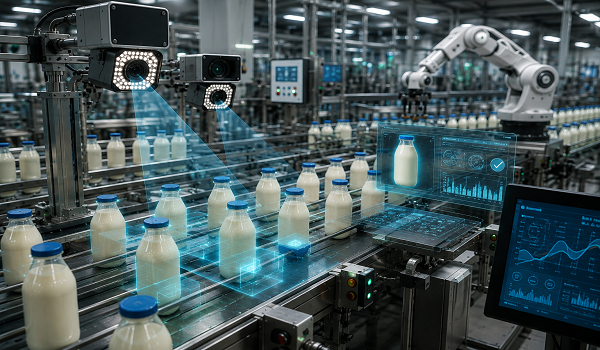
Artificial intelligence is rapidly transforming the global food industry, with smart sensors helping manufacturers improve product quality, enhance food safety, reduce waste, and optimize energy consumption across the supply chain.
A comprehensive review led by researchers at Australia’s Flinders University, published in the Journal of Food Composition and Analysis, highlights how AI-integrated sensing technologies are becoming increasingly important in food production, processing, storage, and distribution.
According to Associate Professor Vi-Khanh Truong, AI-enabled sensing systems are already being used to improve production efficiency while reducing food waste, fuel consumption, and energy use. Traditional food testing methods such as gas chromatography, microbial analysis, and sensory evaluation are often slow, costly, and unsuitable for real-time monitoring. AI-powered alternatives provide faster, non-destructive, and scalable solutions.
The review identified several intelligent sensing technologies being adopted by the industry, including hyperspectral imaging, electronic noses and tongues, Raman spectroscopy, FT-IR spectroscopy, graphene-based sensors, microwave sensing platforms, IoT-enabled devices, and machine learning-assisted multisensory systems. These tools enable continuous monitoring and predictive analysis to detect spoilage, contamination, adulteration, and quality issues.
Among the findings, Raman spectroscopy combined with machine learning achieved up to 99.6% accuracy in detecting milk adulteration, while FT-IR spectroscopy integrated with AI models delivered 100% classification accuracy for edible oil authentication. Researchers also highlighted the use of hyperspectral imaging and convolutional neural networks (CNNs) to identify diseases in pepper crops before visible symptoms appeared.
The study examined machine learning frameworks including support vector machines (SVM), random forests, k-nearest neighbour (KNN), CNNs, long short-term memory (LSTM) models, autoencoders, and ensemble learning systems.
Researchers believe AI can help tackle food waste through spoilage prediction and precision processing tools that reduce energy consumption during drying and refrigeration. Low-power IoT sensors and edge-computing platforms are enabling real-time monitoring across production facilities, warehouses, transportation networks, and retail environments.
Beyond waste reduction, AI-powered sensing technologies are improving traceability, logistics planning, and supply chain efficiency. Electronic nose systems have identified the geographical origin of coffee beans with 97.5% accuracy, while machine learning models are being used to predict spoilage in meat, seafood, fruits, and dairy products.
As sustainability pressures and consumer expectations continue to rise, AI-driven sensing technologies are emerging as a powerful tool for building smarter, more efficient, and more resilient food supply chains.