

Healthy snacking brand Epigamia is accelerating its expansion strategy with plans to double its manufacturing capacity by the third quarter of next year, increase its retail presence to 30,000–35,000 outlets by December 2027 and launch products across three to four new sub-segments, all while funding growth through internal accruals.
The company, which has crossed an annualised revenue run rate (ARR) of more than ₹500 crore, said it has no immediate plans to raise external capital and will continue to focus on strengthening its existing product categories rather than diversifying into unrelated segments.
“We’ve been profitable since last year and are now meaningfully profitable,” said Ritesh Gauba, CEO of Epigamia. “Our strategy is to maintain financial discipline while investing for long-term growth. We continue to operate with the ambition of a high-growth company while retaining the cost-conscious mindset of a startup.”
To support rising demand, Epigamia is investing heavily in manufacturing infrastructure. The company currently operates six manufacturing facilities, including its owned plant in Bengaluru, and is building a large greenfield facility that is expected to increase production capacity by 40–50%. Additional manufacturing projects with strategic partners are also under development through a combination of joint investments and owned facilities.
The expansion is expected to double the company’s overall manufacturing capacity by the third quarter of 2027.
Alongside capacity expansion, Epigamia is strengthening its distribution network. The brand currently reaches around 20,000 retail outlets across more than 200 cities through distributors in over 150 cities. It now aims to expand its footprint to 30,000–35,000 outlets by the end of 2027, with growth supported by new product launches.
The company said distribution quality remains a priority given the fresh nature of its product portfolio.
Epigamia’s omnichannel strategy continues to be driven by digital commerce, with nearly 60% of sales coming from quick-commerce platforms and e-commerce, while traditional offline retail contributes the remaining 40%.
The company expects to sustain its growth momentum, targeting annual revenue growth of more than 50%.
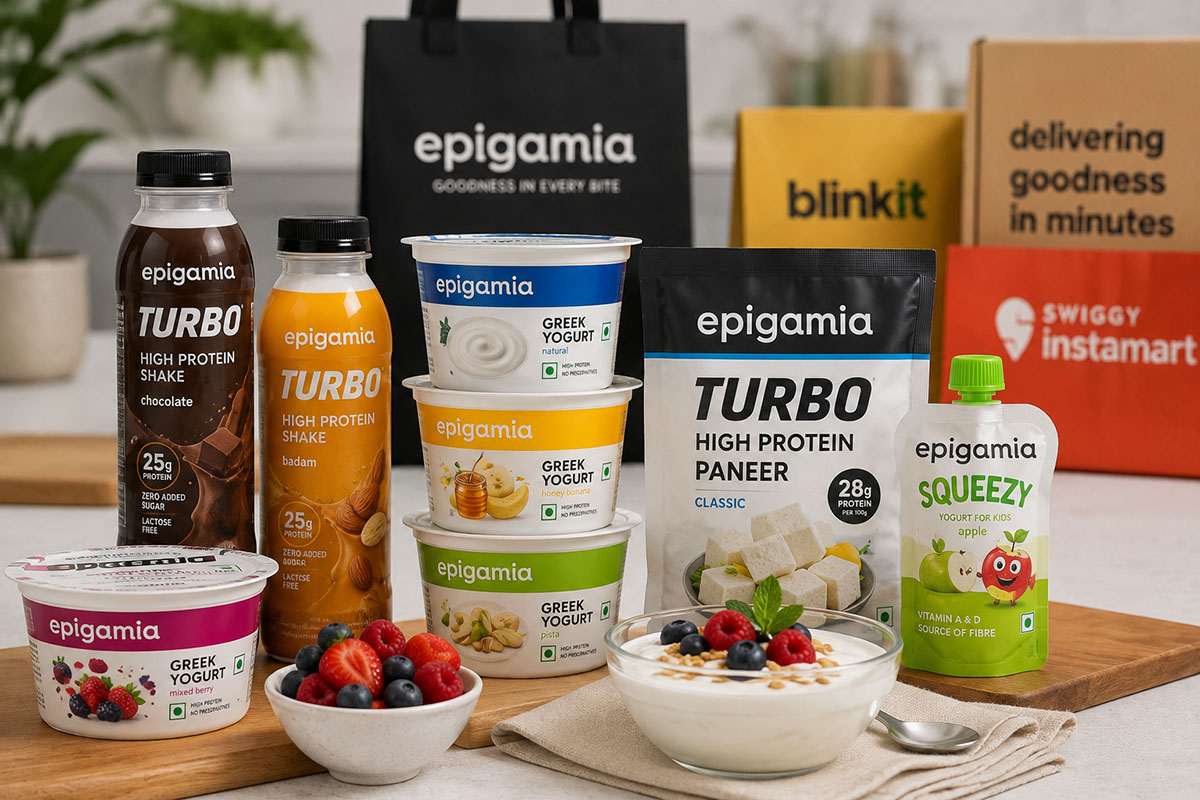
Greek yoghurt remains Epigamia’s largest business segment, accounting for over 60% of total sales. The company’s second major growth platform is Turbo, its high-protein portfolio that includes protein shakes, high-protein yoghurt and high-protein paneer.
Future innovation will remain concentrated around these two platforms. Recently, the company launched Squeezy, a vitamin- and fibre-fortified yoghurt for children, and plans to introduce products across three to four additional sub-segments over the next six to twelve months.
Rather than pursuing rapid diversification, Epigamia said its innovation strategy will continue to focus on developing convenient, clean-label and health-oriented products that align with evolving consumer preferences.
The company allocates around 9–10% of its revenue to marketing, with investments focused primarily on digital platforms, including Meta, Blinkit and Swiggy Instamart, while also strengthening in-store visibility, cold-chain infrastructure and retail sales capabilities.
Despite its aggressive expansion roadmap, Epigamia said it intends to remain self-funded, with future investments financed entirely through operating cash flows, underscoring its confidence in the sustainability of its profitable growth model.