

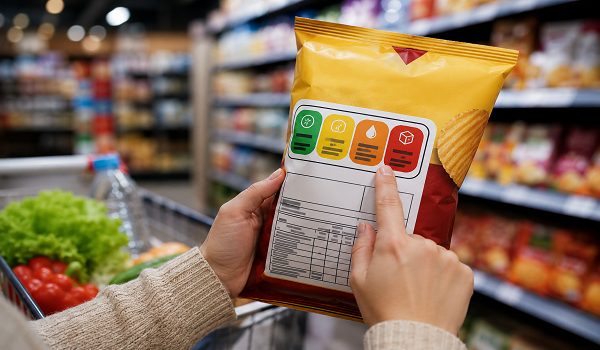
India’s long-delayed front-of-pack nutrition labelling regime is back under the spotlight after a Parliamentary Standing Committee urged the Food Safety and Standards Authority of India (FSSAI) to finalise and notify the regulations within a defined timeline, arguing that consumers continue to be denied clear, easy-to-understand nutritional information at the point of purchase.
In a report tabled in Parliament on Thursday, the Standing Committee on Consumer Affairs, Food and Public Distribution expressed concern that more than two years have passed since the draft Front-of-Pack Nutrition Labelling (FOPNL) regulations were issued in September 2022. While the regulator has received over 14,000 stakeholder comments and continues consultations, the committee said the prolonged delay has stalled the rollout of a simplified labelling framework—particularly one that highlights sugar content in packaged foods.
The recommendation comes at a time when India’s consumption of packaged and ultra-processed foods continues to rise, intensifying scrutiny over how nutritional information is communicated to consumers. The committee argued that the current system, which primarily relies on numerical disclosures such as grams and percentages of recommended dietary allowance, is difficult for many shoppers to interpret quickly while making purchasing decisions.
Instead, lawmakers have called for a more intuitive, front-facing labelling system that allows consumers to assess a product’s nutritional profile at a glance. The committee recommended that the final regulations incorporate colour-coded indicators—red, yellow and green—to signify high, medium and low sugar levels, alongside clear warning labels for products containing excessive sugar.
The panel said such interpretative labels would bridge the gap between technical nutritional disclosures and consumer understanding, enabling healthier dietary choices without requiring shoppers to decode detailed nutrition panels.
The report also underscores the growing policy focus on sugar consumption, particularly in baby foods and processed food products, where concerns over hidden sugars have prompted stronger calls for regulatory intervention.
For India’s food and beverage industry, the eventual implementation of FOPNL rules could mark one of the most significant packaging reforms in recent years. Companies may need to redesign labels, reformulate products to avoid warning indicators, and adapt marketing strategies as nutritional transparency becomes a more prominent factor in consumer purchasing decisions.
The committee has now placed the onus on FSSAI to move beyond consultations and establish a clear implementation roadmap, signalling that regulatory certainty is increasingly becoming as important as the regulations themselves.
If you’d like, I can also make this read even closer to Fortune India‘s editorial style—with a stronger corporate strategy angle, industry reactions, and market implications.