

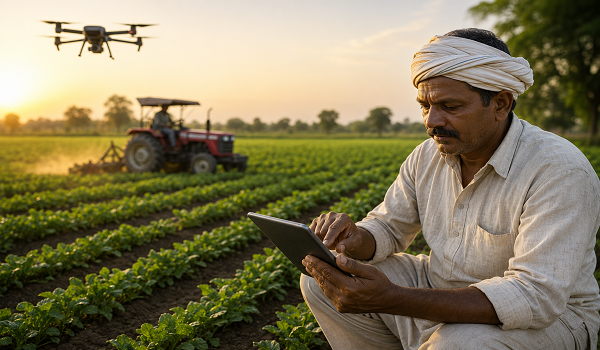
India must move beyond a food security-driven agricultural model and transform farming into a market-oriented, technology-led enterprise, NITI Aayog Vice Chairman Ashok Lahiri said, calling on farmers to respond to changing consumer demand rather than remain focused primarily on traditional staples such as rice and wheat.
Speaking at an Indian Chamber of Commerce event in New Delhi, Lahiri said India has largely overcome the challenge of food shortages and must now focus on improving agricultural productivity, profitability and global competitiveness.
“Farmers should be businessmen,” Lahiri said, stressing that agricultural production should increasingly reflect market demand and higher-value opportunities.
He called for a shift from a production-centric system towards a technology-driven, value-added agri-food ecosystem. Highlighting the productivity gap between Indian agriculture and global benchmarks, Lahiri said wider adoption of high-yielding hybrid seeds, precision agriculture, artificial intelligence, drones, satellite imagery and remote sensing could help raise yields while improving the use of water, fertilisers and other inputs.
Diversification, he said, will be central to this transition. Farmers need to look beyond cereals towards higher-value segments including fruits, vegetables, dairy, poultry, fisheries, goat rearing and agroforestry. Rising incomes and changing dietary preferences are increasing demand for milk, fresh produce, eggs, fish and processed foods, requiring agriculture to evolve alongside consumption patterns.
Lahiri also raised concerns over India’s imbalanced fertiliser use. The country’s average nitrogen-phosphorus-potassium (NPK) ratio stands at around 9.8:3.7:1, compared with the recommended balance of 4:2:1. Heavy dependence on nitrogen-based fertilisers, encouraged partly by low urea prices, is affecting soil health and long-term farm productivity, he said.
Exports represent another major opportunity. Despite producing globally recognised mango varieties and several premium agricultural products, India has yet to fully translate its production strengths into a stronger presence in international markets. Lahiri called for greater emphasis on specialised, high-value agricultural exports.
Food processing and cold-chain infrastructure will also be critical to increasing farmer incomes and reducing wastage. India loses an estimated $18.5 billion worth of food annually, while post-harvest losses in fruits and vegetables are estimated at 15% to 18%. Greater investment in processing, storage, cold chains and logistics could reduce these losses while generating rural employment and creating higher-value products.
Lahiri also stressed strengthening Farmer Producer Organisations (FPOs) to help small farmers access quality inputs, aggregate produce, improve market linkages and negotiate better prices.
On climate-smart agriculture, he cautioned against excessive groundwater extraction through off-grid solar irrigation pumps. Connecting such systems to the electricity grid could allow farmers to sell surplus power, creating an incentive to conserve water while earning additional income.
He said initiatives such as the Digital Agriculture Mission, horticulture and pulses programmes, food-processing support and Union Budget 2026-27 allocations provide a framework for agricultural transformation. However, effective implementation, stronger extension services and faster technology adoption will ultimately determine whether Indian farming can become more profitable, resilient and globally competitive.