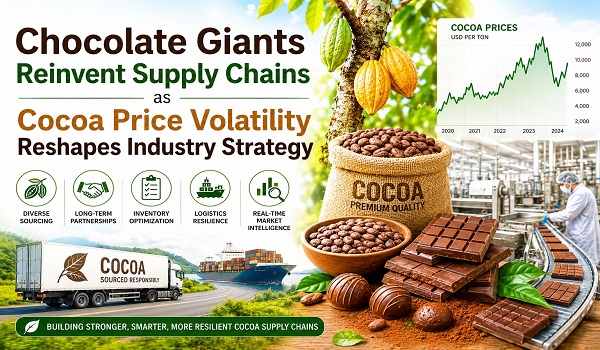

After weathering one of the most volatile periods in cocoa market history, global chocolate makers are redesigning their supply chains, accelerating product innovation and reducing dependence on cocoa to shield themselves from future price shocks—even as cocoa prices retreat from record highs.
Companies including Mondelēz International and Hershey are shifting from short-term cost management to long-term structural changes, betting that climate-related disruptions will continue to make cocoa one of the world’s most unpredictable agricultural commodities.
According to the World Bank, cocoa prices surged to a record US$10,750 per metric tonne (US$10.7 per kg) in January 2025 after extreme weather devastated harvests in West Africa, the world’s largest cocoa-producing region. Prices later fell sharply to US$3.24 per kg in March 2026 before recovering to US$4.36 per kg in June as production improved in Côte d’Ivoire and Ghana, which together account for nearly 60% of global cocoa output.
Despite the correction, industry executives remain cautious, warning that fresh weather disruptions, including a stronger-than-expected El Niño, could once again tighten supplies and push prices higher.
Mondelēz, maker of Cadbury, Toblerone and Milka chocolates, said it is actively working to become a “less cocoa-reliant company.” Speaking during the company’s latest earnings call, Chief Operating Officer Luca Zaramella said the company is investing heavily in supply chain productivity across Europe and North America while exploring new product formulations that use less cocoa.
The company has also stepped up innovation efforts. Earlier this year, Mondelēz became the first major food manufacturer to produce cell-cultured chocolate through a partnership with food-tech startup Celleste Bio. At the same time, it is expanding chocolate products with higher proportions of nougat, caramel, nuts and fruits, reducing the amount of cocoa required without compromising consumer appeal.
Hershey is pursuing a different strategy by strengthening supply chain resilience and improving visibility across cocoa-producing regions. Chief Financial Officer Steven Voskuil recently said the company has diversified its sourcing network, making it less dependent on any single geography while significantly expanding its ability to monitor weather conditions, pollination trends, fertilizer usage and crop yields.
The company believes greater forecasting capabilities will allow it to anticipate supply disruptions earlier and make pricing decisions more gradually, reducing the impact of commodity market volatility on both consumers and margins.
The shift reflects a broader trend across the global confectionery industry, where manufacturers are increasingly treating cocoa volatility as a long-term structural challenge rather than a temporary commodity cycle.