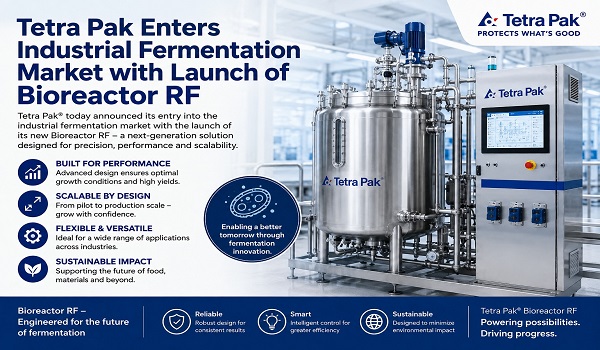

Tetra Pak has expanded its footprint in the rapidly growing new food and industrial fermentation sector with the launch of the Tetra Pak Bioreactor RF, the company’s first industrial-scale bioreactor designed for fermentation-based food ingredient production.
The launch follows Tetra Pak’s acquisition of Bioreactors.net in December 2025 and marks a strategic move to strengthen its portfolio for industrial fermentation and next-generation food manufacturing.
As food manufacturers increasingly adopt fermentation technologies to produce ingredients using microorganisms such as yeast, bacteria and fungi, demand is rising for scalable systems that deliver consistent performance while simplifying operations. The Bioreactor RF has been developed to support this transition from pilot-scale trials to commercial production.
According to the company, the fermentation vessel is designed to provide stable operating conditions and real-time process insights, enabling repeatable performance from pilot validation through to full-scale industrial production without increasing operational complexity.
“Industrial fermentation succeeds when performance is repeatable, day after day. Tetra Pak Bioreactor RF is designed to reduce operational risk and remove complexity, helping operators stay in control,” said Rafael Barros, Director of the New Food Business Stream at Tetra Pak.
The Bioreactor RF is delivered pre-assembled and factory-tested, allowing faster installation and commissioning while reducing disruption to production schedules. Its integrated platform design eliminates the need for separate support structures, which the company says can reduce capital investment costs by up to 8% compared with conventional industrial bioreactors.
A key feature of the system is its patented magnetic agitation technology, which eliminates mechanical seals—a common source of contamination and process instability in traditional bioreactors. The company said the technology maintains efficient power transmission and oxygen transfer across vessel sizes ranging from 10 litres to 50,000 litres, helping minimise contamination risks and reduce the likelihood of costly batch failures.
The bioreactor also incorporates advanced automation, including self-adjusting control functions, predefined operating strategies and integrated data monitoring to reduce manual intervention and improve process visibility. Tetra Pak estimates these features can help lower operational costs by up to 12% through improved process stability and simplified plant operations.
Built on a common design platform across all capacity ranges, the Bioreactor RF enables consistent operator training and easier scale-up while allowing producers to customise configurations, alarm settings and impeller designs as production requirements evolve.
With the launch, Tetra Pak is positioning itself to support the growing industrial fermentation sector, where demand for sustainable, fermentation-derived ingredients and alternative food products is expected to accelerate in the coming years.