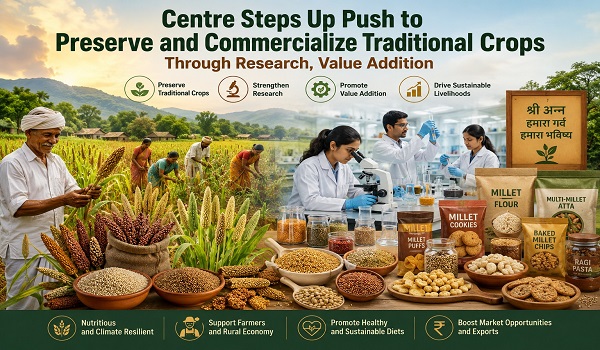

The Centre has intensified efforts to conserve, promote and commercialize India’s traditional agricultural produce and indigenous crop varieties through a combination of research, financial support, intellectual property protection and value addition initiatives aimed at boosting farmers’ incomes and strengthening the country’s agro-biodiversity.
The Indian Council of Agricultural Research (ICAR), through the National Bureau of Plant Genetic Resources (NBPGR) and its network of institutes, is expanding the collection, conservation and documentation of indigenous germplasm. As of July 15, 2026, the National Gene Bank has conserved more than one lakh landraces and traditional crop varieties, providing a rich genetic resource for future crop improvement and climate-resilient agriculture.
To safeguard farmers’ traditional knowledge, the government has strengthened protection under the Protection of Plant Varieties and Farmers’ Rights (PPV&FR) Act, 2001. The PPV&FR Authority has so far registered 5,346 farmers’ varieties, while the National Gene Fund continues to support conservation through benefit-sharing, awards and capacity-building programmes. To date, 45 Plant Genome Saviour Community Awards, 69 Farmer Rewards and 88 Farmer Recognitions have been conferred.
The government has also introduced the ‘Boosting Seed Production of Traditional Varieties’ component under the National Food Security and Nutrition Mission (NFSNM), providing financial assistance for seed production, distribution, capacity building and establishment of seed banks for indigenous varieties.
In the food processing sector, the PM Formalisation of Micro Food Processing Enterprises (PMFME) Scheme is promoting traditional agricultural products through its One District One Product (ODOP) initiative. Products have been identified across 726 districts in 35 States and Union Territories, including makhana, Shahi litchi and Jardalu mango, with support extending to processing, branding, packaging, marketing and value addition.
The Centre is also leveraging Geographical Indication (GI) protection to enhance the identity and market value of region-specific agricultural products, while commodity boards such as the Tea Board, Coffee Board, Spices Board and APEDA continue to promote exports and quality enhancement. The recently established National Makhana Board is expected to further strengthen production, processing and marketing of makhana.
Millets remain a key focus under the government’s ‘Shree Anna’ initiative following the International Year of Millets. The ICAR-Indian Institute of Millets Research (IIMR), Hyderabad, has been designated as the Global Centre of Excellence on Millets, while the Production Linked Incentive Scheme for Food Processing Industry (PLISFPI) includes a dedicated component to encourage millet-based product development and commercialisation.
Research on indigenous crop improvement has also gathered momentum. The ICAR-Indian Agricultural Research Institute (IARI) is implementing 13 projects supported by ICAR, the Department of Biotechnology and the Department of Science and Technology, covering molecular breeding, genomics and genome editing in crops such as wheat, rice, maize, sesame, lentil, cucumber and tomato to develop climate-resilient and disease-resistant varieties.
Among recent outcomes are improved Pusa Basmati rice varieties that contribute significantly to India’s basmati exports, along with two high-yielding Kalanamak rice varieties—Pusa Narendra KN1 and Pusa CRD KN2—developed for GI-designated regions of eastern Uttar Pradesh.
In collaboration with the Alliance of Bioversity International and CIAT, ICAR has documented and evaluated over 5,000 native varieties across 25 crops in 11 states through participatory varietal evaluation. The programme has identified nearly 300 superior traditional varieties for wider cultivation, established almost 50 community seed banks conserving more than 4,000 traditional varieties, and supported nutritional profiling of over 3,000 indigenous varieties to facilitate branding through initiatives such as Native Basket, Mountain Grains and Dhartee Naturals.
The Ministry of Food Processing Industries has also approved 257 research and development projects under the Pradhan Mantri Kisan SAMPADA Yojana, several of which focus on traditional and indigenous produce, including millet-based products, mahua and drumstick.
Collectively, these initiatives reflect the government’s strategy to preserve India’s agricultural heritage while creating new opportunities for value addition, food processing, branding and exports of traditional farm produce.