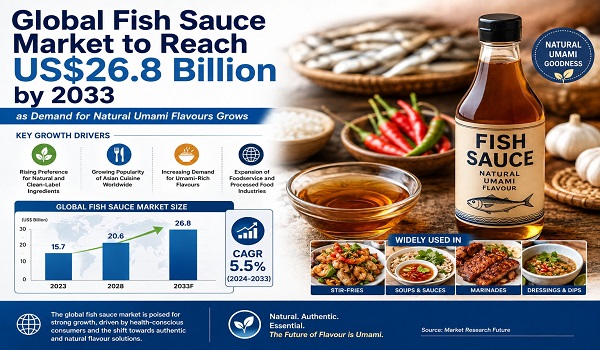

The global fish sauce market is projected to grow from US$17.2 billion in 2024 to US$26.8 billion by 2033, expanding at a compound annual growth rate (CAGR) of 5.1% between 2025 and 2033, according to a report by Growth Market Report.
The market’s growth is being fuelled by rising global demand for authentic Asian cuisine, increasing preference for naturally fermented and clean-label ingredients, and the expanding use of fish sauce in food processing and culinary innovation.
Traditionally regarded as a staple condiment in South and Southeast Asia, fish sauce is increasingly emerging as a strategic value-added seafood product, contributing to exports, livelihoods and food innovation. Growing consumer interest in umami-rich, natural flavour enhancers is transforming the sector from a traditional craft industry into an important segment of the global seafood economy.
Vietnam and Thailand continue to dominate global production and exports, while new opportunities are emerging in South Asia, including India and Bangladesh, where abundant fish resources provide scope for expanding domestic production and exports.
According to the report, the market is being driven by the globalisation of Asian cuisine across North America, Europe and the Middle East, rising demand for natural fermentation-based products, expanding Asian diaspora populations, and the rapid growth of organised retail and e-commerce channels.
For countries such as Bangladesh and India, the report highlights significant opportunities to convert low-value fish, bycatch and seafood processing waste into value-added products. Coastal processing clusters, export-oriented manufacturing and integration with the shrimp processing industry could further strengthen regional competitiveness.
The industry is also witnessing technological advancements, including controlled fermentation systems, biotechnology, AI- and IoT-enabled process monitoring, and the development of low-sodium, organic and premium fish sauce variants tailored to evolving consumer preferences.
However, the report notes that the sector continues to face challenges, including overfishing of small pelagic species, inconsistent quality standards in emerging markets, competition from soy-based and synthetic alternatives, and increasingly stringent international requirements for traceability, food safety and sustainability.
As demand for authentic, naturally fermented ingredients continues to rise globally, sustainability, innovation and value addition are expected to shape the next phase of growth for the fish sauce industry.