

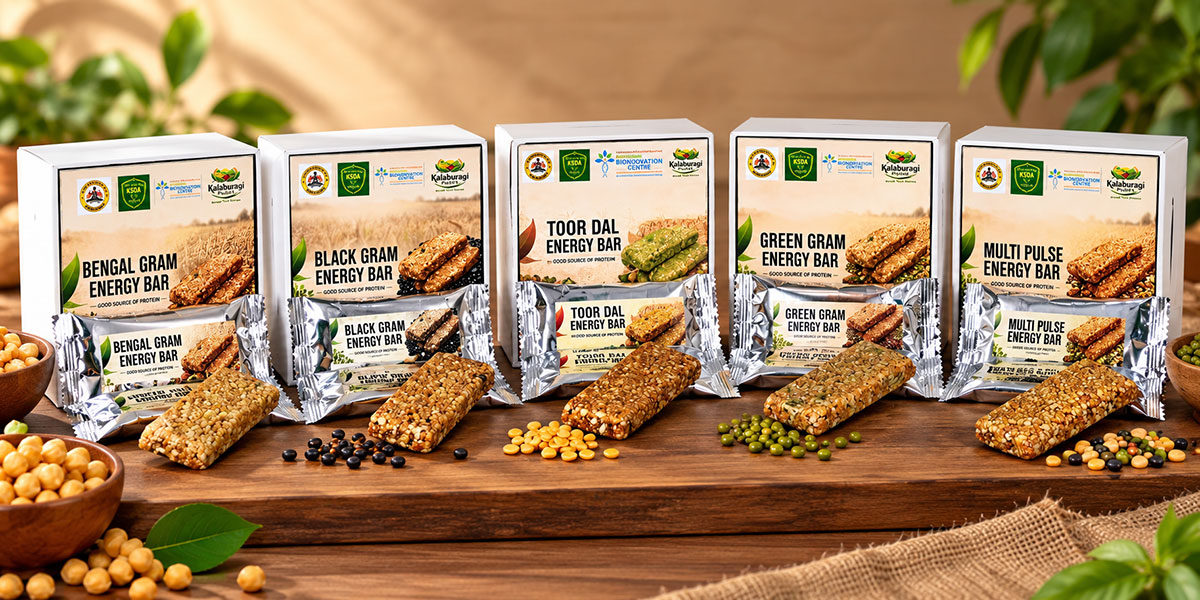
The Bangalore Bioinnovation Centre (BBC) has developed ready-to-eat energy bars using pulses grown in Kalaburagi, Karnataka, as part of efforts to add value to the region’s agricultural produce.
Developed under the Kalyana Karnataka Bio-Economy Mission in collaboration with the Karnataka State Department of Agriculture, the new range includes six variants made from toor dal, black gram, green gram and Bengal gram. The range also features a multi-pulse bar and a higher-protein formulation.
The initiative aims to address a longstanding challenge in pulse-producing regions such as Kalaburagi, where much of the produce is sold and transported as raw grain, while higher-value processing and margins are generated outside the region.
BBC is exploring the use of locally grown pulses to develop shelf-stable, plant-based protein products that can cater to growing consumer demand for convenient and nutritious foods.
The four single-pulse variants use pulse crisps as their main pulse ingredient and are combined with roasted peanuts, jaggery, oats and pumpkin seeds. The formulations do not contain synthetic colours, flavours or chemical preservatives. However, the products’ nutritional claims are subject to final laboratory validation and FSSAI declaration.
Karnataka IT/BT and e-Governance Minister Priyank Kharge said the initiative could help the state move beyond agricultural production towards greater value creation through food innovation.
BBC Managing Director Mohamad Adil AA said the project was aimed at looking at pulses beyond their role as a raw commodity.
The centre plans to transfer the technology to interested farmer producer organisations (FPOs), self-help groups and entrepreneurs in the region. The move could enable local businesses to participate in processing and packaging while retaining a greater share of the economic value within Kalyana Karnataka.
The initiative could allow Kalaburagi’s pulse sector to move up the agricultural value chain, particularly as demand grows for convenient, plant-based and protein-rich foods. If the technology transfer is successfully adopted by FPOs, MSMEs and local entrepreneurs, the project could support local food-processing businesses while creating a stronger packaged-food identity around Kalaburagi’s pulses.
The bigger opportunity, however, will depend on whether these products can achieve commercial scale, competitive pricing and consumer acceptance beyond the region. If successful, the model could also serve as a blueprint for converting other locally produced agricultural commodities into higher-value food products.