

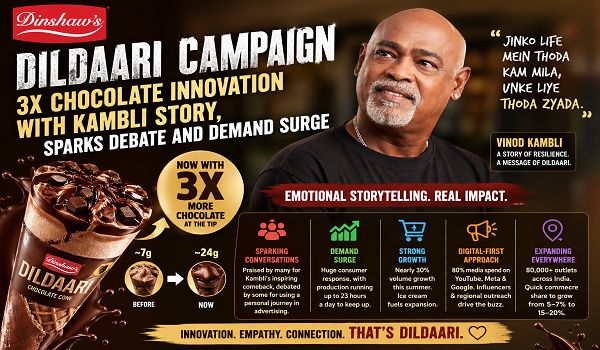
Ice cream maker Dinshaw’s Dairy Foods has launched its ‘Dildaari’ campaign this summer, combining a product upgrade with an emotionally driven narrative featuring former Indian cricketer Vinod Kambli. While the campaign is gaining traction in the market, it has also triggered conversations around the boundaries of storytelling in advertising.
At the product level, the company has enhanced the chocolate content at the tip of its cone from around 7 grams to 24 grams, positioning it as offering “3x more chocolate” and tapping into the consumer delight associated with the last bite.
However, the campaign goes beyond product differentiation. Built around the message “Jinko life mein thoda kam mila, unke liye thoda zyada,” it uses Kambli’s personal journey to underline themes of generosity, resilience, and second chances. The former cricketer—once considered among India’s brightest talents—serves as the emotional anchor of the campaign.
Dinshaw’s said the campaign was conceptualized around the product insight first, with the choice of Kambli aligning with the brand’s narrative of “giving more where it matters.” Company executives noted that interactions with Kambli reinforced their confidence in portraying him as a figure of positivity and renewed optimism.
The campaign, however, has drawn mixed reactions. While many consumers have welcomed Kambli’s return to the spotlight and connected with the campaign’s emotional tone, critics argue that using a complex personal history for commercial messaging risks appearing insensitive or reductive—especially for younger audiences unfamiliar with his cricketing legacy.
Despite the debate, the campaign appears to be delivering business results. Dinshaw’s reported a strong demand surge for its new cones, available in nine flavours, with production units operating for up to 23 hours a day to keep up. The company is currently facing short-term supply gaps due to heightened demand.
The growth is part of a broader momentum, with the brand clocking nearly 30% volume growth this summer. Ice cream contributes roughly half of its business, with higher margins expected to drive further expansion.
On the marketing front, Dinshaw’s has adopted a digital-first strategy, allocating nearly 80% of its media spend to platforms such as YouTube, Meta, and Google, while the rest is directed toward OTT platforms, including non-IPL content on JioHotstar. Influencer collaborations and regional outreach campaigns are also central to its media mix.
Distribution trends are also evolving. While 95% of sales still come from offline channels, quick commerce currently contributes 5–7% and is expected to grow to 15–20% in the coming years, reflecting rising demand for instant, impulse-driven consumption.
The company is simultaneously expanding its retail footprint, currently spanning over 50,000 outlets, with plans to add 10,000–12,000 more annually. Its exclusive parlours, numbering between 100 and 150, are increasingly positioned as brand experience centres rather than primary sales drivers.
Looking ahead, Dinshaw’s is continuing to invest in product innovation, with offerings such as spicy guava and zesty lemon tubs, premium chocolate bars, and an upcoming ice cream pastry variant in the pipeline. The company is also exploring health-focused options like zero-sugar products, while maintaining a strong emphasis on taste.
With ice cream consumption gradually shifting from a seasonal to a more year-round habit in India, Dinshaw’s is betting on a mix of innovation, emotional storytelling, and distribution expansion to sustain growth. The ‘Dildaari’ campaign, in that context, reflects both the opportunities—and the sensitivities—of combining product messaging with real-life narratives.