

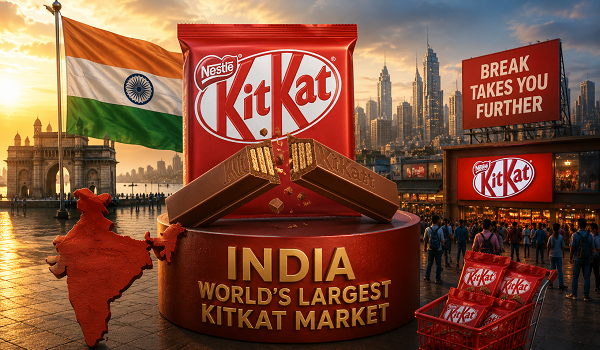
Nestlé has revealed that India has emerged as the world’s largest market for its iconic KitKat chocolate brand, overtaking major markets such as Japan, Brazil, the United Kingdom, and the United States in terms of consumption volumes.
According to the company’s India leadership, nearly 3,950 million KitKat fingers were sold in the country during FY25, highlighting the extraordinary scale of India’s fast-growing packaged confectionery market. A decade ago, India reportedly ranked tenth globally for KitKat sales, but rapid expansion in consumer demand has now pushed the country to the top position.
The development reflects the larger transformation underway in India’s food and beverage sector, where multinational brands are increasingly focusing on affordable indulgence products aimed at a young and aspirational consumer base.
Despite becoming the brand’s biggest market by volume, India also remains one of the cheapest markets globally for KitKat in absolute price terms. A standard KitKat bar in India costs around ₹29, significantly lower than prices in countries such as the UK, the US, and Switzerland.
However, when adjusted for purchasing power and income levels, the picture changes sharply. Analysts comparing KitKat prices with average daily per-capita incomes suggest that Indian consumers spend a much larger share of their daily earnings on the product compared to consumers in developed economies.
The comparison, informally described by market observers as a “KitKat Index” inspired by The Economist’s “Big Mac Index,” indicates that while a KitKat appears inexpensive in nominal dollar terms, it is relatively more expensive for Indian consumers based on affordability ratios.
Industry experts say this reflects a long-term strategy frequently used by multinational food companies in emerging markets: keeping products positioned as “aspirationally affordable” while building mass consumer habits early in the income growth cycle.
Over the years, companies such as Nestlé have used this model successfully across categories ranging from instant noodles to chocolates and confectionery. By establishing brand loyalty and widespread distribution at an early stage, companies aim to benefit later as rising disposable incomes drive higher consumption and premiumisation.
India’s growing role in global confectionery consumption is also being supported by changing lifestyles, expanding urbanisation, increasing youth spending, and the rapid growth of organised retail and quick commerce platforms.
Market analysts believe that if India’s per-capita income continues to rise steadily over the coming decade, multinational food and snack companies with strong retail presence and consumer recall could witness significant gains in both sales volumes and profitability.
The rise of KitKat in India is increasingly being viewed as a larger indicator of the country’s evolving consumer economy, where scale, affordability, and long-term consumption potential are reshaping global food industry strategies.