

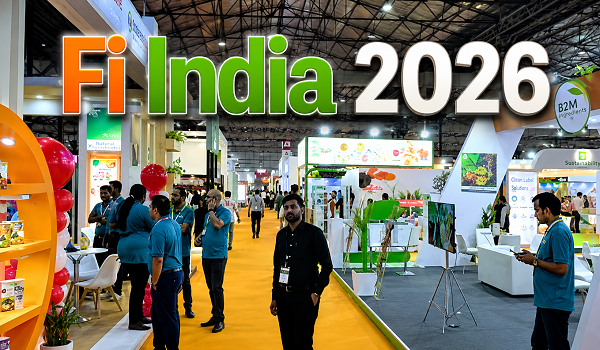
More than 500 exhibitors and 1,500 brands are showcasing ingredients, processing technologies, automation and packaging solutions as India’s food and beverage industry moves towards a more technology-driven growth phase.
India’s food manufacturing ecosystem is getting a major showcase as the 20th edition of Fi India and the 8th edition of ProPak India bring together the country’s ingredients, processing, automation and packaging industries at the Bombay Exhibition Centre.
Held from August 26 to 28, the three-day exhibitions have brought together manufacturers, suppliers, technology providers and industry experts looking to tap into growing demand for food products, ingredients and manufacturing technologies in India.
More than 500 exhibitors and 1,500 brands are participating across the two events, which are expected to attract more than 15,000 food and beverage professionals from over 50 countries.
Fi India accounts for more than 350 exhibitors and 1,200 brands, spanning food additives, colours, flavours, natural ingredients, nutraceuticals, plant extracts, proteins, starches, dairy ingredients, sweeteners, herbs and spices.
ProPak India, meanwhile, features more than 150 exhibitors and 300 brands showcasing processing machinery, packaging equipment, automation systems, coding and marking technologies, filling solutions, converting equipment and supply-chain technologies.
A Growing Food Manufacturing Opportunity
The exhibitions come as India’s food and beverage industry enters a period of rapid expansion. The country’s food additives and ingredients market is projected to reach $15 billion by 2031, while the packaging industry is expected to reach $92 billion by FY2030.
The packaged food and beverage market could surpass $150 billion by 2030, creating opportunities across ingredients, manufacturing equipment, automation, packaging and supply-chain infrastructure.
Government incentives are also supporting the expansion. Under the Production Linked Incentive scheme, India’s food-processing and preservation capacity has increased by 34 lakh metric tonnes per annum, according to industry representatives.
The resulting investment is extending beyond traditional food production into automation, advanced processing technologies and value-added products.
Ingredients and Plant Protein Take Centre Stage
The ingredients sector is emerging as a key opportunity for domestic manufacturing and exports.
Dr Prabodh Halde, Head-Technical Regulatory Affairs at Marico and West Zone Chairman of the All India Food Processors’ Association, said India’s ingredients industry has considerable potential for domestic value addition and overseas markets.
He also emphasised greater collaboration between farmers, processors, research institutions and businesses to build a stronger ingredients ecosystem.
Meanwhile, rising demand for protein-rich and healthier foods is creating opportunities in plant-based nutrition. Praveer Srivastava, Executive Director at PBFIA, pointed to the need to expand domestic manufacturing of plant-protein ingredients, a significant proportion of which is currently imported.
Packaging Moves toward Automation And Sustainability
Packaging is another major theme running through the exhibitions, with manufacturers and technology providers examining the growing use of recycled materials, automation, smart quality-control systems and sustainable packaging solutions.
Fi India is hosting sessions covering food regulations, formulation, gut health, sustainability and emerging ingredients, while ProPak India is focusing on packaging innovation, automation, manufacturing efficiency and emerging technologies.
Together, the exhibitions reflect a broader shift in India’s food manufacturing sector—from simply increasing production capacity to building a more integrated, automated and technology-led value chain.
As India’s packaged food, ingredients and processing markets expand, the convergence of food science, manufacturing technology and sustainable packaging could become increasingly important to the country’s ambition of becoming a larger global food manufacturing hub.