

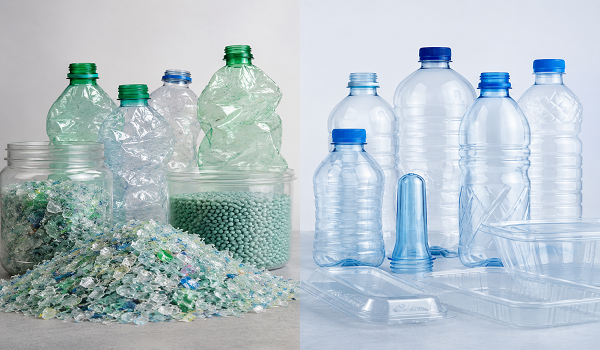
Rising recycled-content mandates, growing PET consumption and investments in automation are reshaping India’s food packaging sector as manufacturers move towards a more circular and technology-led model.
India’s food packaging industry is undergoing a major transformation as stricter sustainability regulations, evolving consumer expectations and new technologies push manufacturers beyond conventional packaging solutions.
The broader Indian food processing industry is projected to reach around $600 billion by 2030, creating significant opportunities for packaging manufacturers and technology providers. Against this backdrop, the packaging sector is increasingly focused not only on protecting food products but also on managing what happens to packaging after consumption.
Industry experts at Fi India and ProPak India 2026 said India’s capacity to produce recycled PET (polyethylene terephthalate) for direct food-contact applications currently stands at about 750,000 tonnes a year. This capacity is expected to increase to approximately 1.1 million tonnes within the next two years.
The expansion comes as recycled-content requirements become progressively more stringent. Mandated recycled content is set to rise from 30% in 2025 to 40%, with requirements eventually expected to reach 50-60%.
At the same time, India’s PET consumption is growing at an annual rate of 10-12% and could accelerate to 14-16%, further increasing demand for recycled materials and recycling infrastructure.
Sustainability Becomes A Design Imperative
The shift is also driving investments in domestic technology. Automatic sorting machinery is being developed in India at substantially lower costs than imported alternatives, potentially helping packaging manufacturers improve recycling efficiency while controlling capital expenditure.
“Industries that integrate sustainability into their cost structure will thrive,” said Rajesh Kumar Gehra, Advisor and Chief Strategist at SIES School of Packaging, describing recycled-content mandates as a design challenge rather than simply a regulatory burden.
The industry is also exploring circular packaging models and AI-driven automation as companies seek to improve material recovery, manufacturing efficiency and product safety.
Chakravarthi AVPS, Global Ambassador of the World Packaging Organisation, said the global packaging industry has already crossed the $1.2 trillion mark, while India is rapidly moving towards a $100 billion market.
Packaging, he added, is increasingly influencing areas beyond presentation, including shelf life, food safety and consumer trust.
The evolution of India’s food manufacturing ecosystem is creating another layer of opportunity. Yogesh Mudras, Managing Director of Informa Markets in India, said growth in the sector is increasingly being driven by innovation, value addition and scalable manufacturing alongside rising consumption.
Fi India and ProPak India 2026 brought together more than 500 exhibitors and 1,500 brands, attracting over 15,000 food manufacturing and packaging professionals from more than 50 countries.
With sustainability requirements becoming more demanding and technology increasingly embedded across the packaging value chain, India’s packaging industry is positioning itself for its next phase of expansion—one that could take the sector beyond the $100 billion valuation mark.