

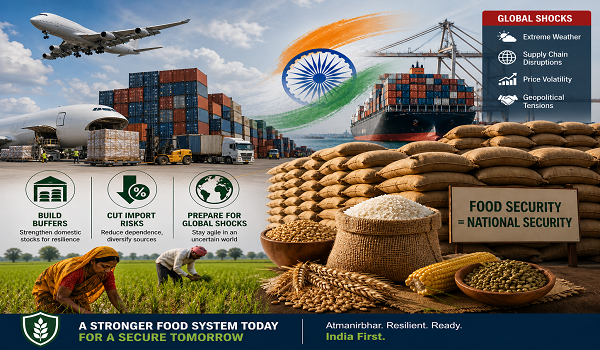
India needs to urgently strengthen its food security framework by mapping vulnerabilities, building larger buffer stocks, and reducing import dependence, as global conflicts continue to disrupt supply chains and drive price volatility, according to S Mahendra Dev, Chairman of the Economic Advisory Council to the Prime Minister.
In an interaction with PTI, Dev warned that ongoing geopolitical tensions, particularly in West Asia, underline the need for a forward-looking approach to managing risks across essential sectors—especially food, fertilizers, and energy.
Food Supply Chains Under Pressure
Highlighting food as a critical area of concern, Dev said India must go beyond traditional reliance on foodgrain reserves and foreign exchange buffers. He called for the creation of stronger physical stockpiles of essential commodities to cushion against sudden supply shocks.
“India must map and monitor vulnerabilities in food and other essential sectors, while proactively addressing supply disruptions and price volatility,” he said, adding that future crises could mirror the scale and unpredictability of current geopolitical conflicts.
The remarks come at a time when global commodity markets have been volatile. Since the outbreak of conflict in West Asia earlier this year, crude oil prices have surged sharply—triggering ripple effects across fertilizer costs, logistics, and food prices.
Need to Reduce Import Dependence
Dev stressed that reducing reliance on imports—especially for inputs like fertilizers and edible oils—will be key to insulating India’s food economy from global shocks. He suggested diversifying sourcing strategies and leveraging trade agreements more effectively to ensure stable supply chains.
At the same time, he pointed out that long-term food resilience is closely linked to energy transition, given agriculture’s dependence on fuel, fertilizers, and transportation.
Building Resilience Beyond Grains
While India has traditionally relied on large foodgrain reserves managed through agencies like the Food Corporation of India, Dev argued that the scope must widen to include a broader basket of essential food and agri-inputs.
He also flagged the need for better logistics, storage infrastructure, and cold chain systems to reduce wastage and improve food availability during disruptions.
Inflation and Growth Impact to Stay Contained
Despite global uncertainties, Dev maintained that the impact on India’s growth and food inflation is likely to remain manageable. Even with elevated crude oil prices, projections indicate controlled inflation levels, supported by government interventions and strong domestic fundamentals.
However, he cautioned that prolonged global instability could strain supply chains further, affecting input costs for agriculture and, in turn, food prices.
Call for Coordinated Action
The government is already deploying a mix of fiscal, trade, and supply-side measures to stabilize the economy, he said, adding that India’s post-COVID emergency response mechanisms have improved its ability to handle such crises.
Dev also called on the private sector to step up investments across supply chains, including food processing and storage, to strengthen resilience.
As global shocks become more frequent, India’s ability to safeguard its food ecosystem—through smarter stockpiling, diversified sourcing, and infrastructure upgrades—will be critical to maintaining both price stability and long-term food security.