

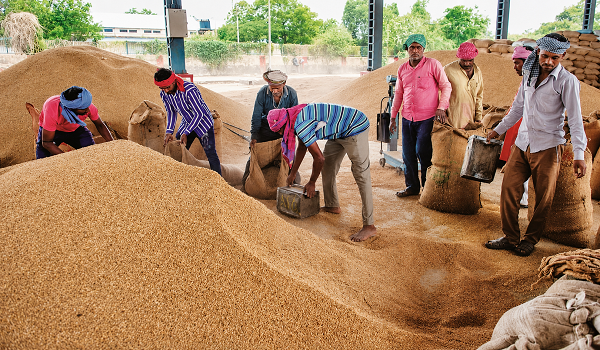
India has once again achieved record foodgrain production, but the latest estimates from the Ministry of Agriculture and Farmers Welfare show that the country’s agricultural story is entering a more complex phase. While production continues to rise across cereals, pulses and commercial crops, the challenge is no longer simply producing more—it is ensuring future growth is sustainable, diversified and aligned with market realities.
The Second Advance Estimates for 2025–26, approved by Union Agriculture Minister Shivraj Singh Chouhan, place Kharif foodgrain production at 1,741.44 lakh metric tonnes (LMT) and Rabi production at 1,745.13 LMT, both registering nearly three per cent growth over the previous year. The figures underline the continued strength of Indian agriculture and reflect favourable production conditions and sustained policy support.
Cereals remain the backbone of India’s agricultural output. Kharif rice production is estimated at a record 1,239.28 LMT, while Rabi rice contributes another 167.20 LMT. Wheat has also reached a historic high of 1,202.10 LMT. Maize has recorded strong growth across both seasons, supported by rising demand from the food, feed and industrial sectors, while millets continue to gain gradual acceptance.
The record cereal harvest, however, also highlights a growing concern. India’s continued dependence on water-intensive crops such as rice and sugarcane raises questions about long-term sustainability, particularly in regions facing groundwater depletion and climate stress.
Pulses and oilseeds have also registered encouraging gains. Tur, gram and lentil production has increased, while rapeseed-mustard has touched a record 133.31 LMT. Despite these improvements, India continues to rely on imports to meet demand for several edible oils and pulse varieties, indicating that structural gaps remain.
Commercial crops have also posted strong numbers. Sugarcane production is estimated at a record 5,001.97 LMT, while cotton output stands at 290.91 lakh bales. Yet both sectors remain sensitive to global prices, export policies and domestic demand. Sugarcane, in particular, continues to draw attention because of its high water consumption.
The latest estimates also reflect improvements in agricultural data collection through remote sensing, Crop Cutting Experiments and multi-source validation, enabling more reliable production estimates for policymakers and the industry.
The figures reaffirm the strength of Indian agriculture but also underline the need for the next phase of growth to focus on resource efficiency, crop diversification and stronger value chains. As the government continues to prioritise farmer prosperity, the real challenge will be balancing record production with long-term sustainability and resilience.