

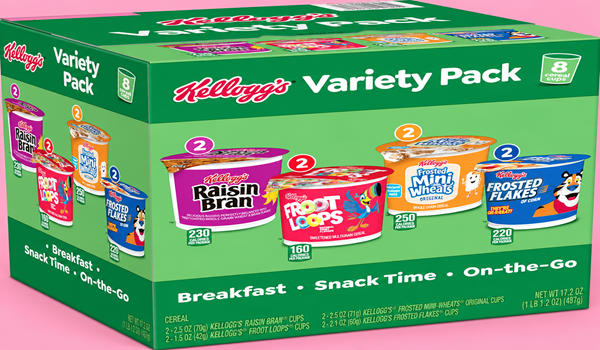
WK Kellogg, the maker of Froot Loops, Frosted Flakes and Raisin Bran, is betting on healthier formulations, clearer nutritional labelling and new consumption occasions to revive a cereal market struggling with declining volumes.
The company is increasing marketing investment and developing products that respond to growing consumer interest in protein, fibre, reduced sugar and simpler ingredients. It is also encouraging consumers to view cereal as a convenient snack rather than a food reserved for breakfast.
The strategy comes as established cereal brands face mounting pressure from changing dietary preferences, concerns about highly processed foods and competition from protein bars, yoghurt and other convenient alternatives.
Ferrero, which acquired WK Kellogg for $3.1 billion in 2025, has committed to investing in the company’s established brands and expanding its presence in breakfast foods.
Falling volumes pose a challenge
According to market intelligence firm Innova Market Insights, cereal market value in the US is projected to exceed $13 billion in 2027, up from $10.7 billion in 2019. However, volumes fell 3% in 2025, marking five consecutive years of decline after a pandemic-driven surge in 2020.
The gap between value and volume indicates that price increases and premium products are supporting revenues even as consumers buy less cereal.
Younger consumers are also increasingly eating cereal as a snack, forcing manufacturers to compete in a broader market that includes confectionery, chips, snack bars and other ready-to-eat foods.
Michele Scott, regional content director for the Americas at Innova Market Insights, has said cereal manufacturers must adapt their marketing, flavours and formats to reflect consumption beyond breakfast.
Reformulating familiar brands
WK Kellogg is attempting to address concerns about sugar and nutritional quality through recipe changes and new product development.
The company says it has reduced sugar content across its cereal portfolio by 10% over the past decade. Its Kashi range includes gut-health-focused granola containing fibre and prebiotics, while Raisin Bran has been reformulated with added protein. Frosted Mini-Wheats highlights whole grains and fibre, and Kashi Go emphasises protein and fibre.
Its Eat Your Mouth Off cereal, launched in 2024, offers 22 grams of protein and zero grams of sugar per serving, according to the company.
WK Kellogg also completed the removal of artificial colours from the remaining 15% of its cereal portfolio that used them in August 2026, a year ahead of schedule. The move followed criticism from consumer advocates over synthetic food dyes and ingredient transparency.
Sarah Ludmer, the company’s chief wellbeing and sustainable business officer, has said the industry needs to communicate cereal’s nutritional benefits more clearly instead of allowing the entire category to be viewed as nutritionally uniform.
New labels highlight nutritional benefits
The company has introduced SPOONS, an on-pack nutrition guide designed to help shoppers identify key product attributes. The acronym stands for simple ingredients, protein, outstanding fibre, other nutritious foods, nutrients consumers need and single-digit sugars.
Front-of-pack messages also highlight individual product benefits, including whole grains, fibre, protein and the absence of artificial colours and flavours.
Marketing is supporting the product changes. In February 2026, WK Kellogg launched its first Super Bowl advertisement in 15 years, featuring Raisin Bran, to renew consumer interest in cereal.
Mintel data cited by the company indicates that 36% of cereal consumers are interested in products offering functional health benefits, while 72% believe brands should explain those benefits clearly on packaging.
However, improved formulations and marketing may not be enough on their own. Consumers must also see value in the products and remain satisfied with their taste, convenience and price.
Competition from better-for-you brands
Brands such as Magic Spoon and Purely Elizabeth have built their appeal around higher protein, lower sugar and ingredients such as whole grains, nuts and seeds.
Their success highlights the difficulty established manufacturers face in changing perceptions of traditional cereal brands, which are often associated with sugary or heavily processed foods.
WK Kellogg has responded with products aimed at nutrition-conscious consumers, while competitor Post has introduced Sweet Dreams, a cereal positioned for evening consumption and late-night hunger.
Ferrero’s acquisition of Purely Elizabeth in 2026 further underscores the strategic importance of better-for-you breakfast products.
Richard Caines, senior food and drink analyst at Mintel, has identified protein, fibre, whole grains and reduced sugar as potential growth areas, while cautioning that innovation alone will not guarantee a category-wide recovery.
Sales decline slows, but recovery remains uncertain
Circana data supplied by WK Kellogg shows that cold cereal sales in the US declined 0.5% in the 52 weeks through June 28, 2026, compared with a 1.5% fall in 2025.
Individual brands performed more strongly during the 13 weeks ending June 28. Kashi sales increased 26.8%, Froot Loops rose 6.2% and Apple Jacks Original grew 2.5%. Raisin Bran and Frosted Mini-Wheats also recently returned to positive sales growth after years of declines.
WK Kellogg’s chief growth officer, Doug VanDeVelde, has said the company’s increased investment and marketing efforts are beginning to influence consumer behaviour.
Nevertheless, Mintel expects cereal volumes to remain broadly flat through 2031, with much of the market’s potential value growth driven by higher prices rather than increased consumption.
The challenge for WK Kellogg is to turn slower declines into sustained growth. That will require consumers to buy cereal more frequently, embrace new products or incorporate it into more eating occasions.
With Ferrero’s backing, the company is betting that nutritional improvements, stronger communication and greater convenience can restore cereal’s relevance. The outcome will depend on whether these changes persuade consumers to return to a category that can no longer rely on tradition and nostalgia alone.