

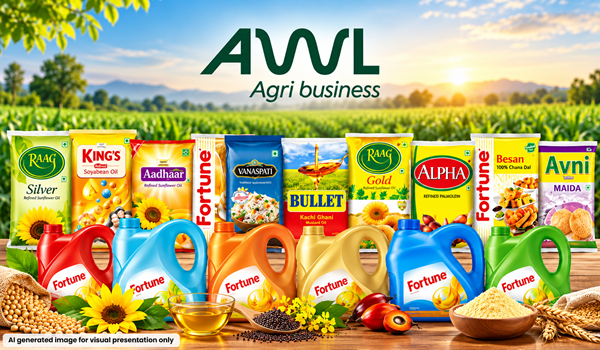
AWL Agri Business is stepping up its focus on packaged foods, branded exports and higher-margin product categories after reporting a slight decline in profit for the September quarter, even as revenue recorded strong growth.
The company reported a 2% year-on-year fall in consolidated net profit to ₹239 crore for the quarter. However, revenue from operations rose 26.1% to ₹22,270 crore, reflecting continued business expansion.
Its food and FMCG business emerged as a key growth driver, with revenue increasing 32% year-on-year to ₹2,216 crore. The segment includes products such as basmati rice, sugar and other packaged food offerings, alongside the company’s broader consumer goods portfolio.
AWL Agri Business plans to strengthen this business by expanding its packaged food range, with a particular focus on premium products, health-oriented offerings and convenient food options. The company also aims to improve profitability by increasing scale and enhancing operational efficiency.
“We will remain very aggressive on wheat flour and rice,” said Shrikant Kanhere, managing director and chief executive officer of AWL Agri Business.
The company also plans to develop its pulses business, which management sees as an attractive opportunity because of its potential for better margins. Expanding across essential food categories could help AWL build a stronger presence in the packaged staples market while diversifying its revenue streams.
Wheat flour, rice and pulses are widely consumed staples in Indian households, offering companies opportunities to develop branded products that combine convenience, quality and consistency. For AWL, the challenge will be to grow these categories while managing input costs and maintaining healthy margins in a competitive market.
Exports are another important part of the company’s growth strategy. AWL intends to expand its branded food exports in markets with significant Indian diaspora populations, particularly the United States, Europe and Australia. Demand for familiar Indian food products among overseas consumers offers an opportunity to take established brands beyond the domestic market.
The export push also reflects a broader strategy of moving beyond bulk commodities towards branded products that can offer stronger consumer recognition and potentially better value.
The latest results highlight the contrasting performance of AWL’s business. While overall revenue and food and FMCG sales registered strong growth, the decline in net profit indicates that higher sales have not translated into corresponding profit growth.
As the company expands its packaged food portfolio and overseas presence, its ability to control costs, improve operational efficiency and develop higher-margin categories will be important in sustaining profitable growth.
AWL’s strategy signals a greater emphasis on building its consumer-facing food business alongside its established edible oil operations. The coming quarters will show whether its investments in branded staples, premium offerings and exports can deliver stronger earnings growth as well as higher revenue.