

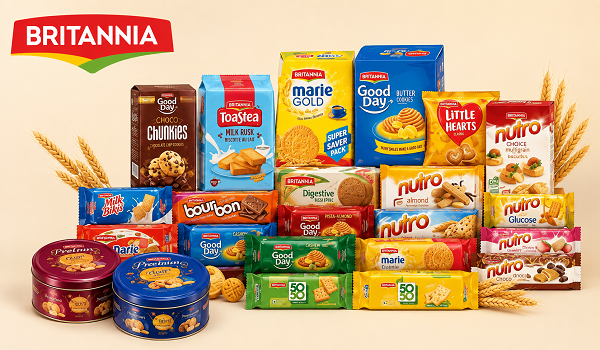
Britannia Industries is seeing stronger consumer demand, with sales momentum improving toward the end of the June quarter, even as rising prices of sugar, palm oil and industrial fuel put pressure on margins.
“The demand environment continues to be strong,” Britannia Industries chief executive Rakshit Hargave said during the company’s quarterly earnings call. However, he said it remains to be seen whether the momentum will continue through the rest of the financial year.
For the first quarter of FY27, Britannia reported a 9.5% year-on-year increase in revenue from operations to ₹4,964 crore, while profit after tax rose nearly 14% to ₹591 crore. Total volumes grew 9%, with the company also reporting sequential market-share gains across its biscuit categories.
Britannia said the improvement was supported by stronger consumer demand and the return of retailers who had earlier reduced purchases during the transition following GST-related changes.
Inventories of dual-priced packs created after the September 2025 GST cuts have largely cleared, allowing retailers to return to normal purchasing patterns. Hargave said the improvement in sales was driven by actual demand and greater retailer participation rather than inventory stocking.
However, higher input costs remain a concern. Prices of key commodities such as sugar and palm oil, along with industrial fuel costs, have increased, putting pressure on profitability.
The company has so far been able to offset around half of the inflationary impact through pricing measures. Britannia is now considering further steps, including price increases as well as changes in pack sizes and packaging.
Hargave indicated that the company could take another 1.5–2% price increase if input-cost inflation continues. For lower-priced packs, Britannia may use a mix of price increases and grammage reductions to maintain affordability.
The company will now have to balance rising costs with consumer affordability as it looks to sustain the improvement in demand through the rest of FY27.