

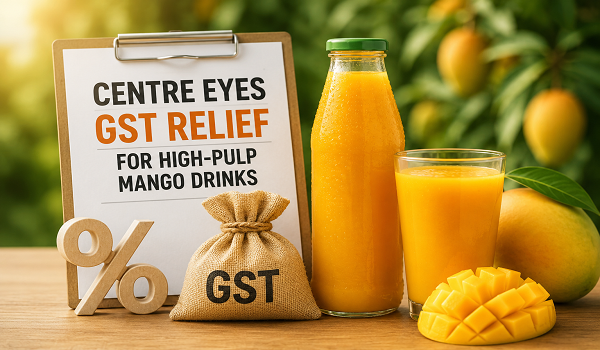
A Centre-appointed expert committee has proposed linking concessional GST on mango beverages to their actual fruit content, recommending that only drinks containing 22-25% natural mango pulp should qualify for the current 5% GST rate. The move is aimed at reviving demand for Totapuri mango pulp, improving farm-gate prices and strengthening India’s mango value chain.
The committee, chaired by T. Damodaran, Director of the ICAR-Central Institute of Subtropical Horticulture (CISH), submitted its report to Agriculture Minister Shivraj Singh Chouhan, who has directed officials to initiate inter-ministerial consultations on the recommendations.
The panel was constituted after a sharp decline in Totapuri mango prices this season across Andhra Pradesh, Tamil Nadu and Karnataka—the country’s principal growing regions.
According to the committee, delayed procurement by processing units, inadequate pulp content in mango beverages sold in the domestic market and volatility in global pulp prices have together weakened demand and squeezed returns for growers.
To address the issue, the panel has recommended that beverages containing less than the proposed minimum pulp threshold should attract a higher GST rate, while products meeting the prescribed pulp content should continue to enjoy the concessional 5% tax. The proposal is expected to encourage greater use of Totapuri pulp in processed beverages while also improving their nutritional value.
The government plans to hold consultations involving the GST Council, FSSAI and the Ministries of Finance, Agriculture, Food Processing Industries and Health to finalise product standards and the revised tax framework.
Beyond taxation, the committee has proposed a series of structural reforms to stabilise the Totapuri market. These include the creation of a Central Coordination and Price Stabilisation Committee for Andhra Pradesh, Tamil Nadu and Karnataka to assess crop forecasts, processing demand, exports and market conditions ahead of every mango season and recommend indicative procurement prices.
The report also highlights the ageing Totapuri orchards in Andhra Pradesh’s Chittoor, Tirupati, Annamayya and Kadapa districts and recommends rejuvenating plantations through top-working, or grafting existing trees with premium mango varieties such as Neelam, Alphonso, Himayat and Banganapalli. Additional measures include promoting Good Agricultural Practices (GAP), farmer training, demonstration plots and fruit-covering techniques to improve quality and reduce insect damage.
The committee has also called for a structured procurement system requiring registered processors in Andhra Pradesh to begin sourcing fruit from May 15 each year, alongside greater participation of Farmer Producer Organisations (FPOs) in value addition. It has suggested promoting products such as mango butter and seed-kernel derivatives to create new income streams for growers.
Agriculture Minister Shivraj Singh Chouhan said the government would work with APEDA, ICAR and state governments to develop a coordinated marketing and export strategy for Totapuri mangoes and processed products. The overarching objective, he said, is to build a farmer-centric Totapuri value chain by aligning GST policy, food safety standards and state-level interventions, while enhancing the global competitiveness of Indian mangoes.