

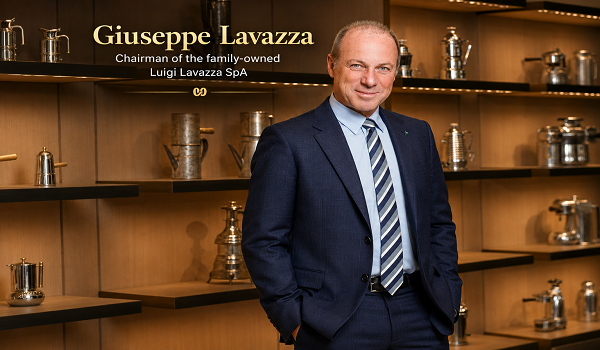
Consumers hoping for cheaper coffee may have to wait longer, with Italian coffee giant Lavazza warning that global coffee prices are likely to remain elevated and volatile for at least the next two years as supply shortages and weather-related risks continue to weigh on the market.
Giuseppe Lavazza, Chairman of the family-owned Luigi Lavazza SpA, said the coffee market remains far from regaining stability, making any meaningful decline in retail prices unlikely in the near term.
“The market needs stability before it’s time to think about reducing prices,” Lavazza said during an interview in London. According to him, the industry will require at least two consecutive strong harvests and a significant rebuilding of global coffee inventories before supply conditions normalise.
His comments come amid renewed turbulence in the arabica coffee market. Earlier this week, arabica futures traded in New York recorded their biggest intraday gain in 26 years before surrendering much of those gains in subsequent sessions, highlighting the extreme volatility that continues to define the market.
Coffee prices have been caught between expectations of a record harvest in Brazil—the world’s largest coffee producer—and mounting concerns that the developing El Niño weather pattern could disrupt production across key growing regions.
“I think we are living in a long-lasting period of instability and uncertainty,” Lavazza said. “Instability is the new constant.”
The premium arabica variety, widely used by global coffee chains and specialty cafés, had retreated from record highs reached in 2025 after forecasts pointed to a bumper Brazilian crop. However, optimism has faded as delayed harvesting, tighter global inventories and renewed weather concerns have reignited fears of supply shortages.
The re-emergence of El Niño has added another layer of uncertainty. The climate phenomenon, which typically brings hotter and drier weather to parts of Brazil during critical flowering periods, has historically affected arabica yields and global coffee supplies. Since meteorologists declared the onset of El Niño last month, coffee prices have climbed by about 30%.
Lavazza said the industry needs sustained production gains from both Brazil and Vietnam—the world’s two largest coffee-producing nations—to restore balance to the market.
“We need a couple of very strong crops from Brazil and Vietnam to rebuild stability,” he said, adding that while the first encouraging harvest may be arriving, there is still insufficient evidence that production will match the optimistic forecasts made late last year.
For coffee roasters, prolonged price volatility is translating into higher input costs and squeezed profit margins, while consumers are likely to continue paying more for coffee across retail shelves, cafés and foodservice outlets.
With climate uncertainty becoming a recurring feature of agricultural markets and global inventories yet to recover, the coffee industry appears set for another extended period of elevated prices and supply-side uncertainty.