

Eternal founder and CEO Deepinder Goyal has played down the threat from newer budget food delivery offerings, saying the company is more focused on building a structurally lower-cost operating model than competing through discounts and reduced commissions.
Speaking after Eternal’s first-quarter FY27 results, Goyal said recent launches such as Rapido’s Ownly and Swiggy’s Toing have so far had only a limited impact on the company’s business. According to him, these platforms largely offer a similar restaurant base and delivery proposition, while attempting to attract customers through lower commissions, reduced delivery costs and cheaper menu pricing.
Goyal said Eternal does not see price-led competition alone as a durable long-term advantage and will instead continue investing in models that can make low-ticket food delivery commercially sustainable.
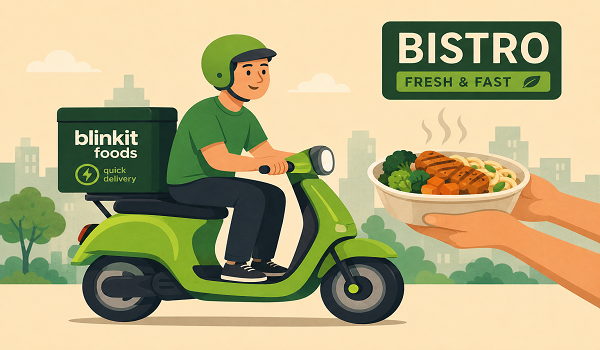
The company’s key bet in this area is Bistro, an in-house initiative designed to serve food in the ₹50–150 range through tighter supply-chain control, standardised production and operational efficiency.
Unlike conventional restaurant delivery, Bistro is being built around limited menus, customised kitchen equipment, automated workflows and high-volume production systems. Goyal said the model is closer to a food manufacturing system optimised for freshness, speed and consistency than a traditional restaurant operation.
The broader aim is to reduce the cost of preparing and delivering affordable meals without depending heavily on sustained discounting.
Eternal is following a similar philosophy in quick commerce. Blinkit CEO Albinder Dhindsa said the company remains focused on expanding infrastructure, assortment and geographic reach rather than pursuing growth primarily through aggressive price cuts.
Dhindsa said investments in fulfilment capacity and network expansion can create operating leverage over time, while prolonged discount-led competition often leads to high cash burn and weak unit economics.
The comments came as Eternal reported a strong June-quarter performance across several businesses.
Consolidated net profit rose 268% year-on-year to ₹92 crore, while revenue from operations increased 182% to ₹20,211 crore. Adjusted EBITDA more than tripled to ₹555 crore.
The food delivery business continued to show momentum, with Net Order Value rising more than 20% year-on-year to ₹10,769 crore, marking the fourth consecutive quarter of accelerating growth.
Blinkit remained one of the group’s strongest growth engines, with Net Order Value rising 86% to ₹17,132 crore. The company added 200 stores during the quarter, taking the network to 2,443 outlets, and reported adjusted EBITDA of ₹102 crore compared with a loss in the same period last year.
Eternal’s District going-out business recorded 60% growth in Net Order Value, while B2B supplies platform Hyperpure reported 27% revenue growth and returned to operating profitability.
As competition intensifies across food delivery and quick commerce, Eternal is signalling a clear strategic preference: rather than entering a prolonged discount war, it wants to lower costs through supply-chain design, infrastructure and operational innovation.
Bistro will now be an important test of that strategy. If Eternal can make ₹50–150 food delivery work with sustainable unit economics, it could open a new mass-market segment without relying on the subsidy-heavy playbook that has defined much of India’s food delivery competition.