

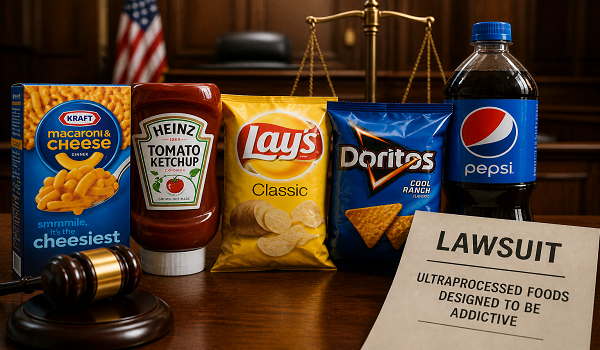
Major global food companies, including Kraft Heinz and PepsiCo, are facing a fresh consumer lawsuit that claims their ultraprocessed products are deliberately engineered to be addictive, intensifying legal scrutiny of the packaged food industry.
The complaint seeks $1 billion in damages and alleges that leading manufacturers designed and marketed foods in ways that promote compulsive consumption—particularly among children. The lawsuit argues that companies adopted strategies similar to those historically used by the tobacco industry.
The case names a dozen multinational players, including Mondelez International, The Coca-Cola Company, General Mills, Nestlé, Kellanova, Mars Incorporated, Conagra Brands and Unilever.
This marks the second major legal challenge targeting ultraprocessed foods, following a lawsuit filed by the San Francisco Attorney General’s Office earlier this year, which accused food manufacturers of contributing to a “public health crisis.”
The latest complaint attempts to address shortcomings identified in an earlier case that was dismissed last year. A judge had ruled that the previous lawsuit failed to establish a direct causal link between processed food consumption and the plaintiff’s health issues, describing the claims as insufficiently substantiated.
In contrast, the new filing provides more detailed allegations connecting dietary patterns to medical outcomes. The lead plaintiff, Olivia Kreie, claims she developed Type 2 Diabetes as a teenager, arguing that such conditions were rare in children before the widespread consumption of ultraprocessed foods.
The lawsuit outlines her consumption habits, citing frequent intake of branded products such as Capri Sun beverages and breakfast cereals like Reese’s Puffs as part of her regular diet before diagnosis.
Food companies have consistently denied wrongdoing and are actively contesting such claims. Legal experts note that establishing a direct cause-and-effect relationship between processed foods and specific health conditions remains a significant challenge for plaintiffs.
Meanwhile, parallel legal battles are unfolding across the U.S. In a related development, legal representatives for PepsiCo recently succeeded in shifting a separate case filed by San Francisco authorities back to state court, a move that could influence the scale and destination of potential damages.
Additionally, the industry has secured temporary relief against state-level regulatory efforts targeting additives and artificial ingredients, with courts blocking or delaying legislation in regions such as Texas and West Virginia.
The wave of litigation reflects a broader attempt to position ultraprocessed foods alongside tobacco in public health discourse—an approach that, if successful, could reshape regulation, labelling norms, and marketing practices across the global food industry.
However, with courts demanding stronger scientific evidence and clearer causal links, the outcome of these cases is likely to hinge on how convincingly plaintiffs can connect product formulation, consumption patterns, and long-term health effects.