

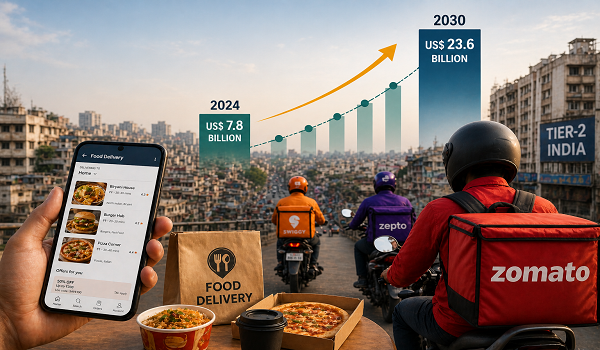
India’s online food delivery sector is entering a high-growth phase, with market size projected to nearly triple to around $27 billion by 2030, driven by increasing order frequency, expanding reach in Tier-2 and smaller cities, and rising consumer spending, according to a report by Investec Equities.
The sector, currently valued at $9.1 billion in 2024, is expected to grow at a compound annual growth rate (CAGR) of 19%, reflecting a structural shift in how Indians consume food—moving from occasional ordering to habitual usage.
The report highlights that the next phase of expansion will be led less by new user additions and more by increased engagement. India had an estimated 85 million annual transacting users in 2024, with only 27% placing monthly orders. This conversion rate is expected to rise steadily as ordering in becomes a routine behaviour.
Changing lifestyles—such as smaller households, longer working hours, and urban migration—are accelerating demand for convenience-led food consumption. Younger, working consumers are increasingly relying on delivery platforms for daily meals.
While metro and Tier-1 cities continue to dominate, contributing nearly 75–80% of gross order value, Tier-2 and smaller cities are emerging as key growth engines, already accounting for 20–25% of the market.
This geographic expansion is being supported by improved logistics networks, deeper restaurant partnerships, and smartphone penetration, enabling platforms like Zomato and Swiggy to scale beyond urban strongholds.
Average order values (AOVs) are also on an upward trajectory, driven by premium restaurant offerings, wider cuisine options, and bundled orders. Industry estimates suggest AOVs could reach ₹542 by 2028, growing at 6–8% annually.
Consumers currently place 3–5 orders per month on average—significantly lower than 8–10 in the U.S. and 5–10 in China—indicating substantial headroom for frequency-driven growth.
The broader food services market in India has grown from ₹4 trillion in FY20 to ₹7 trillion in FY25 and is expected to reach ₹11–12 trillion by FY30. Within this, the organised segment—including branded chains, cloud kitchens, and delivery-first formats—is rapidly gaining share.
Its contribution has risen from 36–41% in FY20 to 47–52% in FY25 and is projected to reach up to 65% by FY30, underpinned by consistency, hygiene standards, and scalability.
Online food delivery, in particular, remains the fastest-growing segment, expanding from ₹270 billion in FY20 to ₹790 billion in FY25, and is expected to more than double again by the end of the decade.
Despite rapid growth, online delivery still accounts for just 11% of India’s total food services market, compared to much higher penetration in developed economies. This gap, combined with evolving consumption habits, positions India as one of the most promising food delivery markets globally.
As digital adoption deepens and food habits evolve, the sector’s growth story is expected to be driven by frequency, affordability, and deeper regional penetration—marking a decisive shift from novelty to necessity in India’s food consumption landscape.