

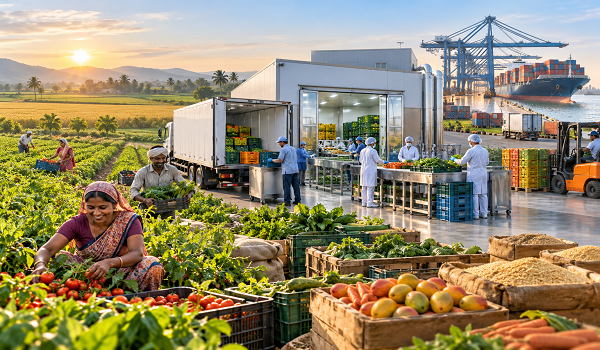
India is seeking to raise the share of agricultural produce undergoing processing to 25–30% from the current 16–17%, as the government looks to capture more value from farm output, reduce post-harvest losses and strengthen the country’s position in global food trade.
The target was outlined by J.P. Dongre, Deputy Agricultural Marketing Advisor and Director at the Ministry of Food Processing Industries, during a precursor event in New Delhi for Anuga Select India and Anuga FoodTec India 2026. The exhibitions are scheduled to be held from September 29 to October 1 at the Bombay Exhibition Centre in Mumbai.
According to Dongre, India’s food-processing level has risen considerably over the past decade, moving from around 3–4% to 16–17%. The next objective is to take it to 25–30% by 2030 or 2047, bringing the country closer to processing levels in leading European markets. He valued India’s food-processing industry at more than US$500 billion, indicating considerable scope for investment and expansion.
The government’s approach focuses on building the infrastructure needed to convert agricultural commodities into higher-value products. MoFPI is extending financial support to micro, small, medium and large enterprises investing in modern processing machinery, packaging systems and cold-chain facilities. Such investments can improve efficiency, extend shelf life and help businesses meet food-safety, quality and export requirements.
Formalisation of small businesses is another important part of the strategy. Dongre said around two lakh micro food-processing entrepreneurs had been brought into the formal economy over the past five years under the PM Formalisation of Micro Food Processing Enterprises scheme. The government plans to formalise more units during the next five years. This could help small operators improve processing practices, hygiene and packaging while gaining better access to finance and organised markets.
Reducing wastage is a major reason behind the processing push. An earlier government study estimated that India loses agricultural produce worth more than ₹1.5 lakh crore through post-harvest losses. Better storage, warehousing, refrigeration and processing could preserve more of this output and turn it into marketable products instead of allowing it to deteriorate.
The opportunity also extends to exports. Pawel Stachowiak, Counsellor for Trade and Economic Affairs at the European Union, said bilateral agrifood trade is currently worth around €5 billion and could reach approximately €10 billion by 2032. The proposed India–European Union Free Trade Agreement, which the EU hopes will be signed by the end of 2026, could reduce tariffs and improve market access. However, he stressed that businesses must convert the agreement into actual commercial partnerships.
Amit Lohani, Founder and Director of the Forum of Indian Food Importers, said nearly 30% of the organisation’s members now also operate as exporters and manufacturers through joint ventures. This changing profile reflects India’s broader transition from primary production towards processing, branding, packaging and export-ready value addition. The 25–30% target places that transition at the centre of the country’s food-economy growth strategy.