

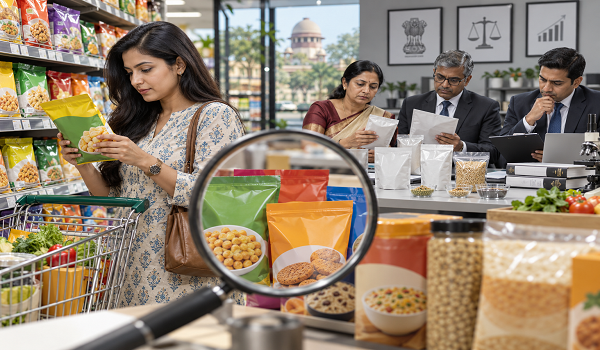
In India’s crowded packaged-food market, words such as “100%”, “healthy”, “natural”, “energy” and “no added sugar” can strongly influence purchasing decisions. Increasingly, however, these familiar marketing expressions are also attracting scrutiny from regulators, lawyers and senior company management.
The Food Safety and Standards Authority of India said in August that it had issued more than 150 notices in recent months over misleading advertisements, false claims and breaches of labelling rules. Major companies named among the recipients included Nestlé India, PepsiCo India, Coca-Cola India, Mondelez India and Abbott India. The action signals that claims once handled mainly by marketing teams are becoming matters of legal compliance, financial exposure and corporate reputation.
Pressure is also building around front-of-pack nutrition labelling. FSSAI has proposed prominent red warnings for packaged foods high in added sugar, added saturated fat and salt. Under the proposed phased system, the first stage would cover products exceeding limits for at least two specified nutrients, along with certain sweetened beverages. A later stage would extend warnings to products exceeding the limit for any one of the three nutrients.
For manufacturers, the front of a packet is valuable commercial space. It has traditionally been used to communicate taste, quality and aspiration. A visible warning could change consumer perception, affecting sales and encouraging reformulation. It would also make the scientific evidence behind every nutritional claim more important.
Absolute claims are proving particularly sensitive. Ankush Bhardwaj, Managing Partner at Ace Lex, said companies using expressions such as “100% Organic”, “No Sugar”, “Chemical-Free” or “Whole Wheat” should obtain independent verification. Comparative claims should also be supported by credible market surveys or consumer research.
The issue has reached the courts. In August 2026, the Delhi High Court restrained FSSAI from taking steps to cancel ITC’s licence over the statement “100% Atta, 100% Madhya Pradesh Wheat, 0% Maida” used for Aashirvaad MP Chakki Atta. ITC had challenged FSSAI’s May 2025 advisory directing food businesses to discontinue “100%” claims on labels, packaging and promotional material. The case illustrates the tension between commercial language and regulatory interpretation.
Changing a claim can impose substantial costs. A company may need to redesign packaging, withdraw advertising, revise formulations or temporarily delist a product. Smaller and direct-to-consumer brands can be more exposed because they often have limited legal, scientific and regulatory resources.
A LabelBlind Solutions study examining 5,058 claims across 586 packaged-food products found that 33.6% were either non-compliant or lacked adequate substantiation under relevant food, advertising and consumer-protection rules. Of the claims examined, 21.3% were classified as non-compliant and 12.3% required brand verification. Non-compliance reached 29% in plant-based beverages and 27.3% in snacks.
Ashwin Bhadri, founder of Equinox Labs, said some businesses are shifting budgets from marketing to quality checks because compliance is now viewed as non-negotiable. As consumers examine ingredients and nutrition more closely, credibility may itself become a competitive advantage. In this environment, every prominent statement on a packet must carry evidence as well as marketing appeal.