

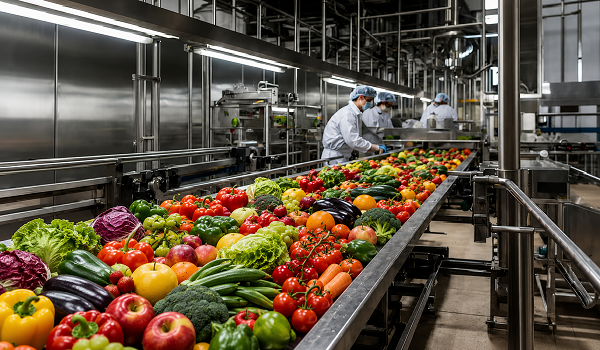
India is preparing for a major expansion of its food processing sector, with the Centre aiming to increase the share of agricultural produce that undergoes processing from the current 10–12% to nearly 25% over the next five years.
Union Minister for Food Processing Industries Chirag Paswan outlined the target while speaking at Coca-Cola India’s event marking 50 years of Maaza. He said the government’s broader vision is to build a stronger farm-to-factory ecosystem by bringing processing infrastructure closer to agricultural production centres.
If achieved, the target could significantly expand value addition in Indian agriculture, reduce post-harvest losses, create new income opportunities for farmers and strengthen India’s position in global food exports.
Paswan said India currently processes only a relatively small share of its agricultural output compared with the potential available across the country’s vast food economy. The sector, he noted, continues to offer substantial headroom for investment, manufacturing and value creation.
Processing Closer to the Farm
A key part of the government’s strategy is to encourage decentralised processing infrastructure rather than concentrating capacity only in large industrial centres.
Paswan said small and medium food processing units located closer to farms and agricultural clusters could help reduce wastage, improve supply-chain efficiency and enable farmers to realise better value from their produce.
The larger objective is to create an integrated value chain connecting agricultural production with processing, packaging, logistics and distribution.
Such a model could also support the development of regional food clusters, improve market access for farmers and create employment opportunities closer to rural production centres.
Policy Support Driving Investment
Paswan also highlighted the role of policy reforms in attracting greater investment into the food processing sector.
Among the major government initiatives supporting the industry are the Pradhan Mantri Kisan Sampada Yojana (PMKSY), the Pradhan Mantri Formalisation of Micro Food Processing Enterprises (PMFME) scheme and the Production-Linked Incentive (PLI) scheme for food manufacturing.
The government has also allowed 100% foreign direct investment in food processing, creating a more open environment for domestic and international investment.
According to Paswan, the Ministry of Food Processing Industries has emerged as one of the stronger-performing ministries under the PLI framework, reflecting growing industry participation in value-added food manufacturing.
Industry Asked to Build Consumer Trust
Alongside expansion, Paswan stressed the need for food companies to maintain high standards of quality, transparency and consumer communication.
He urged the industry to address misinformation surrounding processed foods through science-backed communication and clearer labelling.
The minister emphasised that food processing should not be viewed only through the lens of packaged or convenience foods. It also plays a wider role in reducing agricultural wastage, extending shelf life, improving food availability and converting raw produce into higher-value products.
From Agricultural Powerhouse to Value-Added Food Economy
India is already one of the world’s largest producers of agricultural commodities, but much of the country’s produce continues to be sold with limited processing and value addition.
Expanding processing capacity could help bridge this gap.
Greater investment in food processing can create demand for agricultural produce, strengthen rural supply chains, support manufacturing jobs and increase the share of value retained within the domestic economy.
It can also help Indian food companies move beyond exporting raw commodities towards higher-value packaged, processed and branded products.
The government’s 25% processing target therefore represents more than an industrial growth objective. It signals a broader attempt to transform India’s agricultural economy by creating stronger links between farms, food factories and consumer markets.
If the target is achieved, food processing could emerge as one of the most important engines connecting agricultural growth with manufacturing, exports and rural income generation over the coming decade.