

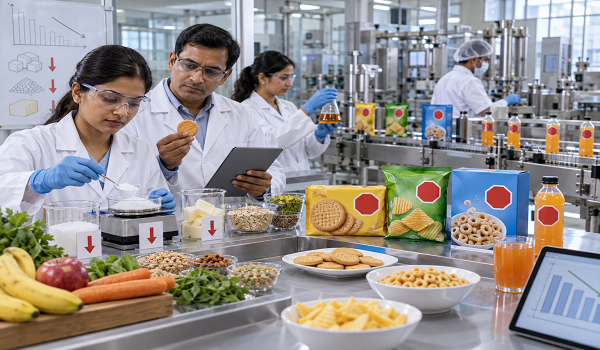
India’s packaged-food companies are beginning to change their recipes even before the final rules for front-of-pack warning labels are settled. Manufacturers of biscuits, noodles, snacks, soft drinks and frozen foods are accelerating efforts to reduce sugar, salt and saturated fat as they prepare for the system proposed by the Food Safety and Standards Authority of India.
The decision to move early reflects the time required to reformulate a mass-market product. Reducing sugar, salt or fat without changing familiar taste, texture, shelf life or price can take six to eight months or longer. As one executive at a large packaged-snacks company observed, manufacturers cannot simply wait for the final verdict when lengthy research, testing and consumer trials may be required.
FSSAI has proposed prominent red hexagonal warnings on products crossing prescribed nutrient thresholds. Its suggested two-phase approach would initially cover foods high in at least two specified nutrients, as well as certain highly sweetened beverages. A later phase would cover products exceeding the threshold for even one nutrient. The matter is before the Supreme Court, which on September 10 asked FSSAI to clarify the proposed implementation within 10 days.
Despite the uncertainty, businesses are treating reformulation as a commercial priority. Anand Ramanathan, Partner and Consumer Industry Leader at Deloitte South Asia, said Indian and global packaged-food companies are accelerating reductions in excess salt, sugar and fat across their portfolios. A prominent warning on the front of a pack could influence buying decisions, particularly in high-volume categories where small changes in consumer preference can have a large effect.
Multinational businesses are also moving faster than some of their global deadlines. Coca-Cola, Nestlé, Danone, Kellogg and PepsiCo have made voluntary nutrition commitments through the International Food and Beverage Alliance. India’s importance as a growth market, combined with the possibility of warning labels, has created an additional reason to advance those targets.
Nestlé India said in its FY26 annual report that it continued to reduce salt, added sugar and fat while using Nestlé SA’s research capabilities to protect taste. The company previously launched more than a dozen Cerelac variants without refined sugar after questions were raised about differences between formulations sold in India and Europe. Britannia Industries reported that it reduced sugar by around 3.50% and sodium by 12.23% across its portfolio during FY2025–26 against its FY2018–19 baseline.
The work goes beyond adjusting a recipe. Saurya Bhattacharya, Partner at JSA Advocates & Solicitors, said reformulation may require changes to suppliers, contracts, manufacturing processes and capital deployment. These decisions are especially sensitive in a market built around fixed price points such as ₹10, where even a small ingredient or packaging change can affect margins.
Beverages offer an early indication of the shift. Coca-Cola is expanding distribution of its zero-caffeine, zero-sugar cola, while Lahori Zeera, Campa, Raw Pressery, Zyro and other brands are competing in the zero-sugar segment. Company data cited in the report suggests zero- and low-sugar drinks now account for around 30–35% of India’s soft-drinks market, up from roughly 5% in 2020.
The debate over thresholds continues, with the National Institute of Nutrition supporting warnings when even one nutrient exceeds the limit. Whatever the final model, reformulation has already moved from a future compliance question to a present-day product and growth strategy.