

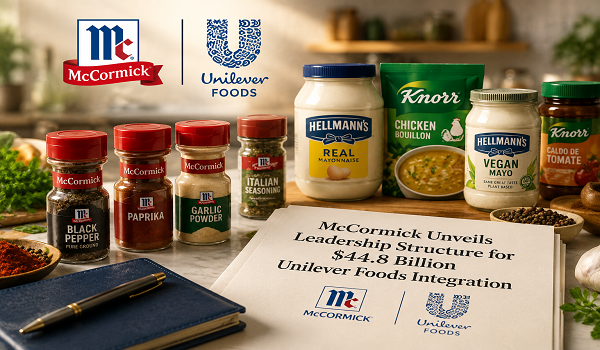
McCormick & Company has unveiled the operating structure and leadership team for its proposed combination with Unilever’s food business, providing a clearer picture of how the global spice and flavour major plans to integrate the largest acquisition in its history.
McCormick agreed four months ago to acquire the majority of Unilever’s food business, including major brands such as Hellmann’s and Knorr, in a $44.8 billion transaction expected to close by mid-2027. The combination would significantly expand McCormick beyond its traditional strength in spices and seasonings, creating a much broader global business spanning condiments, consumer foods, food service and industrial flavour solutions.
Under the proposed structure, the combined company will operate through four global divisions—Americas Consumer, International Consumer, Global Food Service and Global Flavor. Executive operations will be maintained across McCormick’s headquarters in Hunt Valley, Maryland, and a new international headquarters in the Netherlands.
“Our planned operating model is designed to place consumers and customers at the center of the combined business, enabling disciplined execution, enhanced innovation, and sustainable long-term growth,” McCormick President and CEO Brendan Foley said.
The structure is designed to combine global scale with greater regional market focus. The consumer business will be divided geographically, allowing brands and products to be adapted to local tastes while sharing capabilities across the wider organisation.
Americas Consumer is projected to represent approximately $8 billion in annual sales based on 2025 figures and will be led by Andrew Foust, who currently heads the integration process. International Consumer, with projected annual sales of around $7 billion, will be headed by Unilever Foods President Heiko Schipper.
McCormick is also placing significant emphasis on its business-to-business operations. Global Food Service is expected to generate approximately $4 billion in annual revenue and will be led by Nuria Hernandez, currently head of Unilever’s food service business.
The Global Flavor division, meanwhile, is projected to account for around $2.5 billion in annual sales. Led by Suzanne Roy, the business develops customised flavour and ingredient solutions for food and beverage manufacturers.
This segment has become increasingly important as manufacturers seek new flavour systems, reformulate products, reduce artificial ingredients and optimise formulation costs.
McCormick also plans to pursue a secondary listing on the London Stock Exchange following the transaction, aimed at expanding its international investor base, improving share liquidity and reflecting the company’s enlarged global footprint.
The scale and complexity of the acquisition have raised questions among investors over integration risks. Analysts at TD Cowen have pointed to uncertainty surrounding the condition of Unilever’s food operations and the challenges involved in executing such a large transaction. However, the newly outlined operating framework could help address some of those concerns by providing clearer leadership and accountability across the combined business.
Once completed, the acquisition is expected to substantially expand McCormick’s international presence and create a powerful food platform spanning household brands, food service, spices, seasonings and customised flavour solutions for manufacturers worldwide.