

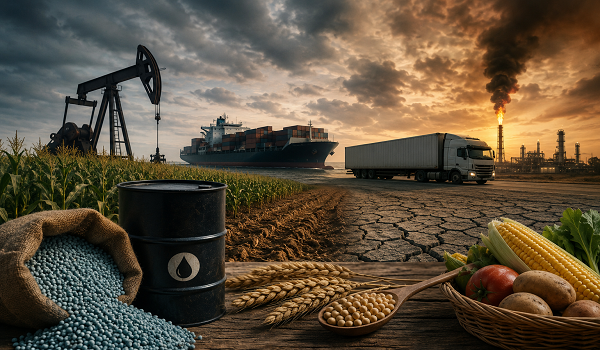
The continuing conflict between the United States and Iran is beginning to cast a long shadow over global food systems, with economists warning that rising oil, fertilizer, and transportation costs could intensify food insecurity across both developing and developed nations. According to economist Bernhard Dalheimer, the crisis is no longer just geopolitical — it is rapidly evolving into an economic and humanitarian challenge affecting agricultural profitability, food affordability, and global trade.
Dalheimer explained that oil shocks impact the food economy mainly through fertilizer prices, transportation costs, and biofuel-linked pressures. Disruptions around the Strait of Hormuz, a critical global oil transit route, have already pushed up crude oil prices, leading to higher freight and fertilizer costs that directly affect food production and distribution.
Developing countries across Africa and Asia are expected to face the sharpest impact, as transportation and energy costs form a much larger share of food prices in these regions. “In several developing economies, transportation alone can account for nearly half the cost of food,” Dalheimer noted, adding that poor infrastructure and long supply chains worsen the burden.
While global food stocks remain relatively stable due to strong harvests in recent seasons, experts warn that affordability and access — rather than availability — are becoming the larger concern. Rising fuel prices are making it increasingly expensive to move food from farms to consumers.
Dalheimer also cautioned that sustained high fertilizer costs could influence planting decisions and crop productivity in the 2027 agricultural cycle. At the same time, climate pressures, including severe heatwaves, El Niño, and growing weather volatility, are further increasing uncertainty in global agriculture.
Another major concern is the rise of export restrictions during periods of economic stress. Dalheimer warned that when countries impose export bans to protect domestic consumers, global food markets become more fragile, triggering further price spikes and instability.
Instead, he advocated open trade, diversified sourcing, and stronger food storage systems as more resilient long-term solutions. “Food producers are paying more for fertilizers and transportation, while consumers are facing higher retail prices. In this case, nobody truly benefits,” he said.
As geopolitical tensions and climate volatility continue to intensify, analysts believe global food supply chains may face even greater stress in the coming months.