

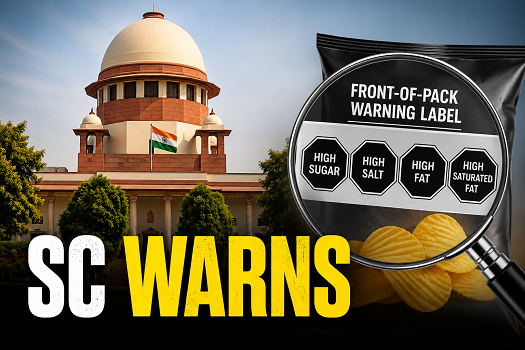
New Delhi: The Supreme Court on Thursday pulled up the Food Safety and Standards Authority of India (FSSAI) over its failure to act on an earlier direction to consider mandatory front-of-pack warning labels for packaged foods high in sugar, salt and saturated fat.
A Bench of Justices JB Pardiwala and K Vinod Chandran gave the Centre two weeks to place its final decision on the issue before the court, warning that it could issue its own directions if the government fails to act.
“If you can’t do it, we will,” the Bench said.
The court’s remarks came after FSSAI proposed an alternative labelling framework that would display recommended daily intake limits for added sugar, saturated fat and salt rather than prominent warnings identifying products high in these ingredients.
Under the proposal, consumers would be informed of recommended daily limits of 25 grams of sugar, 10 grams of saturated fat and 5 grams of salt, based on the 2024 ICMR-NIN Dietary Guidelines for Indians.
Court questions FSSAI’s approach
Kerala-based non-profit organisation 3S and Our Health Society, which filed the public interest litigation, argued that the proposed system would require consumers to read the nutrition table, find the relevant figures and compare them with recommended limits.
The petitioner said this would undermine the purpose of front-of-pack labelling, which is intended to help consumers make quick and informed choices.
The Bench expressed strong displeasure with FSSAI’s approach and questioned why the regulator had not followed the court’s earlier direction to consider prominent warnings.
Justice Pardiwala also questioned whether FSSAI was facing pressure from the food manufacturing industry and indicated that the court could frame directions itself if the regulator failed to act.
“This is your last chance. Next time we will dictate the judgment,” the Bench warned.
Court prioritises consumer health
The Supreme Court also rejected the argument that international food-labelling standards could not be applied in India.
The Union government had raised concerns that such standards could result in traditional foods, including namkeen and eggs, carrying warning symbols. It also cited the potential impact on micro, small and medium enterprises, a significant portion of whose revenues are linked to traditional food products.
The Bench was not persuaded by these arguments and stressed that public health must remain the central consideration.
The court observed that manufacturers may oppose warning labels if they affect sales, but consumers have a right to know what they are consuming.
It also emphasised that the proceedings were not directed at any particular product or manufacturer but were concerned with the broader issue of public health, particularly the health of children.
SC had sought prominent warnings in February
The latest intervention follows the Supreme Court’s February 10 order, when it expressed dissatisfaction with FSSAI’s earlier compliance affidavit and said the regulator’s exercise had not produced any “positive or good result”.
The court had then asked FSSAI to consider prominent warnings such as “High Sodium Level”, “High Sugar Level” and “High Saturated Fat Level” on packaged food products.
The PIL has highlighted the rising incidence of diabetes, obesity and other non-communicable diseases and argued that prominent warnings could help consumers make healthier dietary choices.
FSSAI had previously told the court that it was conducting further research, mapping packaged food products, carrying out consumer surveys and reviewing international practices before finalising the framework.
The Supreme Court’s latest order gives the Centre a final opportunity to reconsider its position before the court considers issuing directions of its own.