

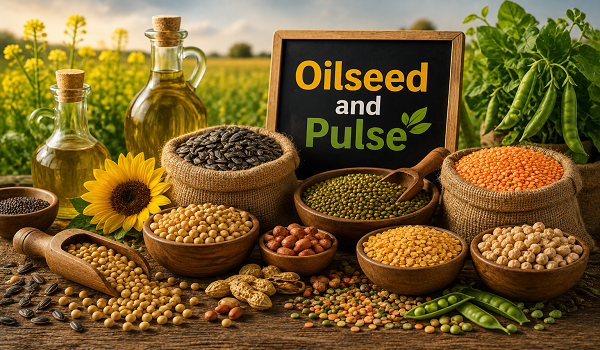
The Centre is intensifying efforts to increase domestic production of oilseeds and pulses as part of a broader strategy to strengthen food security and reduce India’s dependence on imports of edible oils and pulses.
The push is being driven by two national missions focused on improving farm productivity through better seeds, modern cultivation practices, infrastructure development and stronger market linkages. The National Mission on Edible Oils–Oilseeds (NMEO-OS), approved in October 2024, aims to increase primary oilseed production from 39 million tonnes in 2022-23 to 69.7 million tonnes by 2030-31. The Mission for Aatmanirbharta in Pulses, launched in October 2025, targets an increase in pulse production from 242 lakh tonnes to 350 lakh tonnes by 2030-31.
Under the oilseed mission, the government has adopted a cluster-based production approach linked to markets. More than 600 Value Chain Clusters have been operationalised, with Farmer Producer Organisations, cooperatives and other agencies involved in their management.
Farmers are being provided free, high-quality seeds of newly developed high-yielding varieties, along with training in improved agricultural practices. The programme also supports post-harvest infrastructure, including the establishment and upgrading of oil mills to improve oil recovery. Frontline demonstrations at cluster and block levels are being used to encourage the adoption of improved varieties and cultivation techniques.
During 2025-26, free seed distribution through Value Chain Clusters covered 13.52 lakh hectares, while another 4.44 lakh hectares had been covered during kharif 2026. The Centre has also sanctioned 60 seed hubs and 50 specialised seed-storage units to support the production and storage of breeder seeds for newly released varieties.
Oilseed production has shown an upward trend. According to the third advance estimates of the Department of Agriculture and Farmers Welfare, production increased from 413.55 lakh tonnes in 2022-23 to 430.59 lakh tonnes in 2025-26.
The government is also supporting growers through procurement of oilseeds at Minimum Support Price under the Pradhan Mantri Annadata Aay Sanrakshan Abhiyan (PM-AASHA).
Domestic availability of edible oils increased from 124.23 lakh tonnes in 2022-23 to 126.30 lakh tonnes in 2024-25, according to the Directorate of Sugar and Vegetable Oils. During the same period, edible oil imports declined from 165 lakh tonnes to 160.72 lakh tonnes.
A similar effort is underway in pulses, with the government focusing on higher productivity and wider availability of quality and climate-resilient seeds. The pulses mission covers seed production and distribution, demonstrations of improved technologies, farmer training, free seed kits and investment in post-harvest infrastructure.
During 2025-26, demonstrations covering 4.79 lakh hectares were conducted to promote improved production and crop-protection technologies. Around 4.33 lakh quintals of quality seeds were produced and 3.10 lakh quintals of certified seeds distributed. Farmers also received 9.25 lakh seed kits free of cost.
To support better price realisation, the Centre is facilitating assured procurement of tur, urad and masoor from registered and willing farmers through NAFED and NCCF under PM-AASHA, based on requirements submitted by states.
The third advance estimates show pulse production increasing from 242.46 lakh tonnes in 2023-24 to 274.09 lakh tonnes in 2025-26. Pulse imports, meanwhile, declined from 72.56 lakh tonnes in 2024-25 to 59.64 lakh tonnes in 2025-26.
The figures indicate gradual progress towards greater self-reliance, although India continues to depend significantly on imports, particularly for edible oils. The government’s strategy is therefore focused on strengthening the entire domestic value chain—from improved seeds and higher farm productivity to processing, procurement and market access.